With 38,257 student pilots currently training across the Sunshine State as of March 2026, is the window of opportunity still wide open, or is the market becoming too crowded for new arrivals? It's natural to feel a sense of urgency or worry that the high cost of training might not pay off before the hiring boom stabilizes. You want to ensure your investment leads directly to a seat in a major airline cockpit. If you're researching an ATP flight school Florida offers, you're likely looking for a path that balances training speed with the elite decision-making skills required for modern aviation.
We understand the pressure of choosing between Part 61 and 141 programs while trying to reach your professional goals. This guide provides the most current 2026 data on Florida pilot demand, regional salary projections, and the most efficient training paths available today. You'll discover how training in high-density airspace like Central Florida prepares you for an industry where the average Florida airline pilot earns $161,801 annually. We will explore the hiring trends and localized training plans, such as a Career Pilot Program, that turn your aspirations into a tangible professional destination.
Key Takeaways
- Understand why the 2026 pilot shortage has evolved into a demand for highly trained professionals rather than just warm bodies in the cockpit.
- Explore current 2026 salary data and signing bonus trends to build a realistic financial plan for your aviation training investment.
- Discover why Central Florida's weather and proximity to major hubs like Orlando International make it the premier location for year-round flight training.
- Learn how the Wings Foundation provides the essential PPL fundamentals you need to launch a professional career with confidence.
- Evaluate how a structured Career Pilot Program can accelerate your journey from zero experience to the flight deck, offering a localized alternative to a standard ATP flight school Florida.
The 2026 Aviation Landscape: Is the Pilot Shortage Still Real?
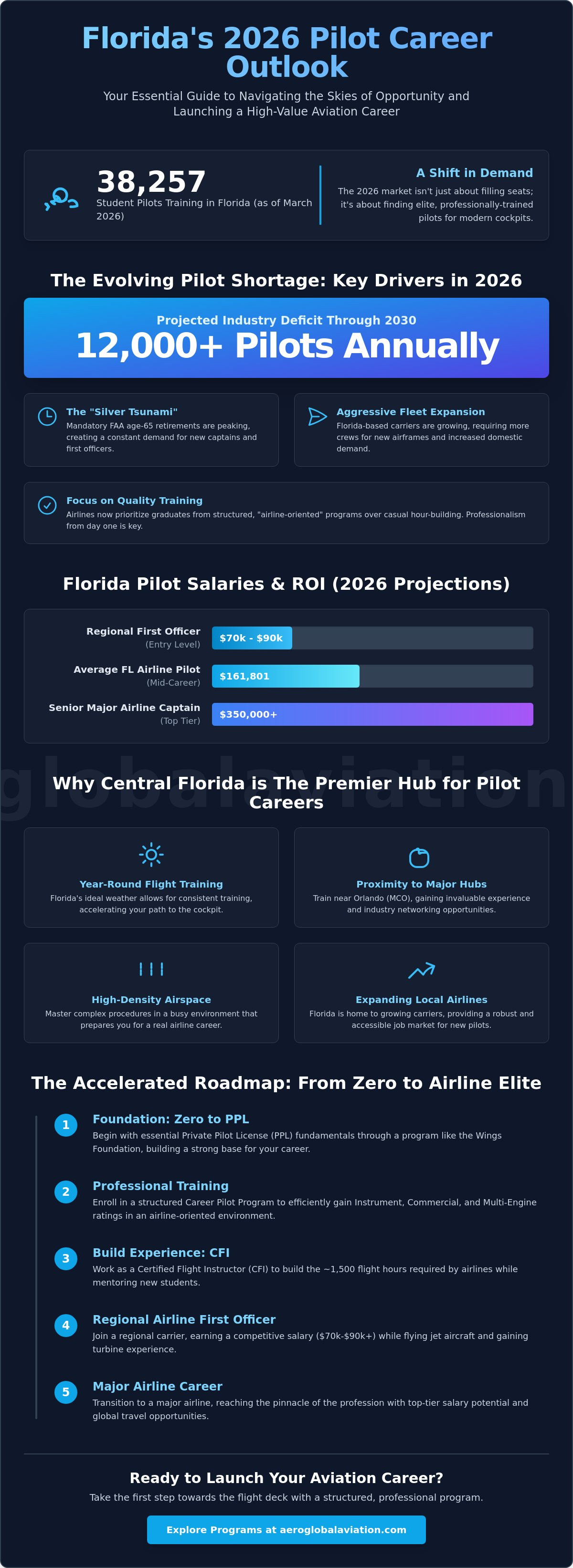
As you look toward the horizon of 2026, the question isn't just whether airlines are hiring, but who they are choosing to lead their crews. The pilot shortage remains a significant factor in the industry, yet it has matured into a more nuanced supply-demand gap. This gap is largely fueled by the mandatory FAA age-65 retirements that are currently removing some of the most experienced captains from the flight deck. While you might hear conflicting reports, the reality for those researching an ATP flight school Florida provides is that the demand for fresh, professional talent has never been more focused. The industry expects a deficit of over 12,000 pilots annually through the end of the decade.
To gain a thorough pilot profession overview, you have to look at how the role has evolved from a technical job into a high-stakes leadership position. Airlines aren't just looking for anyone with a license; they're looking for individuals who have been immersed in a professional environment from day one. In 2026, the "shortage" is specifically an opening for well-trained, professional pilots who can step into high-tech cockpits and maintain the highest safety standards.
Mandatory Retirements and Fleet Expansions
The "Silver Tsunami" of retiring captains is reaching its peak in 2026, creating a vacuum that flows all the way down to regional carriers. These regional airlines serve as the primary hiring engine for new graduates in Central Florida, acting as the essential bridge to the major airlines. At the same time, Florida-based carriers like Spirit and Silver Airways are aggressively expanding their narrow-body fleets to handle increased domestic demand. This expansion means more airframes are arriving, and each one requires a full rotation of qualified crews to keep them in the air.
The Shift Toward Quality Training
Hiring managers in 2026 have shifted their focus toward quality over quantity. The old method of casual hour-building is being replaced by a preference for candidates from structured academy backgrounds. Airlines prioritize "airline-oriented" training that mirrors the checklists, safety protocols, and flight deck environments of a professional carrier. Understanding the airline pilot career path is vital because it highlights how elite certifications and standardized procedures make you a safer, more employable pilot. Choosing an ATP flight school Florida path that emphasizes these professional standards ensures you aren't just building time, but building the specific skills that major airlines value.
Projected Pilot Salaries and ROI in Florida for 2026
Investing in your wings is a decision that fundamentally reshapes your financial future. In 2026, the average airline pilot in Florida earns approximately $161,801 per year, with senior captains at major carriers often exceeding the $350,000 mark. While the initial investment in training is significant, the 30-year career earnings potential starting from a Florida base far outweighs the upfront costs. You aren't just paying for a license; you're securing a seat in a high-demand industry where signing bonuses and tuition reimbursement programs have become standard tools for attracting top talent. When you evaluate an ATP flight school Florida path, it's vital to look past the first year and see the lifetime of professional security it provides.
The financial reality of the first year has changed dramatically. New graduates stepping into First Officer roles at regional airlines are seeing total compensation packages between $70,000 and $90,000. These figures are backed by official pilot salary and outlook data, which highlights a robust growth trajectory for the profession through 2034. Beyond the base pay, Orlando-based crews enjoy significant lifestyle benefits, including flexible scheduling and travel perks that allow you to see the world while building a local life in Central Florida.
Regional vs. Major Airline Compensation
For those flying out of Orlando International (MCO), the path to a major airline is faster than ever. Rapid flow-through programs now allow pilots to transition from regional jets to major airline cockpits in record time. Regional starting pay in 2026 has nearly doubled compared to the industry standards seen only a decade ago, reflecting the intense competition for qualified flight crews. This upward trend ensures that your transition from a flight instructor to a commercial professional is both swift and financially rewarding.
The Financial Advantage of Accelerated Training
Timing is everything in aviation. Finishing your training just six months earlier can result in an extra year of Captain-level pay at the end of your career, a difference that can amount to hundreds of thousands of dollars. By utilizing a structured approach to commercial pilot training, you can reach your required flight hours more efficiently. Students in the Kissimmee area benefit from localized training plans that maximize flying days, ensuring you stay on schedule to meet your goals. If you're ready to take the first step toward these rewards, starting your journey today with a dedicated mentor can make all the difference in your long-term ROI.
Why Central Florida is the 2026 Hub for Pilot Careers
Central Florida has solidified its position as the beating heart of the aviation industry for 2026. While many students look for an ATP flight school Florida has to offer, the most successful candidates focus on the specific strategic advantages of the Orlando and Kissimmee corridor. This region isn't just a place to log hours; it's a high-intensity classroom where the skies mirror the complexity of professional airline routes. Navigating Orlando’s busy airspace prepares you for the fast-paced communications and split-second decision-making required in the cockpits of major carriers. You'll graduate with a level of comfort in complex environments that rural programs simply can't replicate.
Proximity to major training centers and world-class simulator hubs creates a unique networking ecosystem. You aren't training in isolation; you're surrounded by the very infrastructure that supports the Bureau of Labor Statistics pilot career outlook for a decade of robust growth. This environment fosters a professional mindset from your very first solo, placing you in constant contact with the technology and people driving the industry forward. It's about being in the right place at the right time to catch the eye of recruiters who frequent this aviation hub—a strategic approach to visibility similar to how Global AI Reps helps businesses capture and convert high-intent prospects.
The Strategic Value of Kissimmee (KISM)
Choosing to base your training at Kissimmee Gateway Airport (KISM) provides a distinct tactical advantage. KISM offers a perfect blend of controlled and uncontrolled environments, allowing you to build diverse skills without the frustrating ground delays common at massive international hubs. It's often called the Aviation Capital of Florida for good reason. You'll have immediate access to modern maintenance facilities and fuel services that keep your training moving at a professional pace. When you evaluate how pilot training in Kissimmee stacks up against coastal schools, the lack of corrosive salt air and more predictable inland patterns often lead to better aircraft availability and fewer maintenance interruptions.
Weather, Terrain, and Training Efficiency
Efficiency is the key to reaching the flight deck sooner. Florida’s 2026 season offers over 300 flying days per year, a statistic that puts northern flight schools at a significant disadvantage. Consistent VFR weather means you can fly almost every day, which is crucial for preventing "skill fade" between lessons. If you're looking for an ATP flight school Florida experience that respects your timeline and your budget, the Orlando area delivers unparalleled reliability. Within a 50-mile radius, you can practice in Class B, C, and D airspaces, ensuring that by the time you reach your checkride, you're already comfortable in the environments where airlines operate. This diversity makes every hour in your logbook more valuable to future employers.
The 2026 Roadmap: From Zero to Airline Elite
Transitioning from a curious observer to a professional aviator in 2026 requires a structured progression that transforms technical knowledge into instinctive leadership. While many students look for an ATP flight school Florida provides, the most successful ones follow a strategic roadmap designed for the modern airline environment. Your journey begins with the Wings Foundation, where you master the fundamental mechanics of flight. From there, you advance through instrument and commercial ratings, eventually entering the Career Pilot Program to bridge the gap toward the 1,500-hour milestone. Finally, the Airline Pilot Elite program provides the advanced certifications and interview preparation needed to secure your seat at a regional carrier. This isn't just about passing tests; it's about building a professional identity that airlines trust.
Building the Foundation with Wings
The first 40 to 60 hours of your training are the most critical for your long-term success. During this stage, you aren't just learning to land; you're developing the safety habits and decision-making frameworks that will stay with you for your entire career. Learning how to get your private pilot license in Florida involves mastering the complex Orlando airspace from day one. This high-intensity environment ensures that your first solo flight isn't just a personal milestone, but a demonstration of your ability to manage professional-level communications and traffic patterns. By starting with a strong foundation, you ensure that every subsequent rating is easier to achieve.
Accelerating to the Commercial Level
Once you've mastered the basics, the focus shifts toward professional-grade flying. The transition from the Wings Foundation to a PPL to CPL program is where you learn to fly for hire. In 2026, the Multi-Engine Rating has become the golden ticket for airline hiring, as it proves you can handle the complexity of the aircraft you'll eventually fly for a major carrier. To reach the mandatory 1,500-hour requirement, many students choose to become a Certified Flight Instructor (CFI). This role allows you to build time while getting paid, refining your own skills by teaching the next generation of pilots. It is the most efficient way to maintain momentum while preparing for the Airline Pilot Elite phase of your career. If you're ready to commit to this professional path, apply to join our academy and start your journey toward the flight deck today.
Choosing an ATP flight school Florida path means choosing a location that works as hard as you do. By following this structured roadmap in Central Florida, you're placing yourself in the center of the aviation world. Each step is designed to build upon the last, ensuring you arrive at your airline interview with the confidence, hours, and elite certifications that top-tier carriers demand in 2026.
Launching Your Career at Aero Global Aviation Academy
Choosing the right environment to complete your training is the final and most important piece of your professional puzzle. While many students initially search for an ATP flight school Florida path for its perceived speed, they often discover that a "pilot factory" model lacks the individual attention required to master complex modern systems. Aero Global Aviation Academy provides an alternative that prioritizes your individual success. We move beyond impersonal training cycles to offer a personalized mentorship experience that treats you as a future captain from your very first day. Our academy is designed to be your local partner in Central Florida, ensuring you have the support and resources needed to thrive in the 2026 hiring market.
To prepare you for the flight decks of major carriers like Delta, United, or American, we utilize a modern fleet equipped with G1000 glass cockpits. This technology mirrors the advanced avionics found in modern airliners like the A320 and B737, making your eventual transition to heavy jets a natural progression rather than a steep learning curve. By training in a professional environment that leverages the strategic advantages of our Kissimmee location, you're building a network within the Central Florida aviation corridor that will serve you throughout your career.
The Aero Global Advantage
Our Airline Pilot Elite program is specifically crafted to enhance your hireability in a competitive 2026 landscape. We don't just stop at the minimum requirements; we focus on advanced instructor certifications that demonstrate a higher level of mastery to airline recruiters. Every lesson is grounded in our Practical Mentor philosophy, where experienced instructors provide the warm encouragement and professional authority you need to build confidence. Our proximity to Orlando's massive aviation industry means you're training alongside regional hiring partners who recognize the quality of our graduates and the high standards we maintain.
Next Steps for Aspiring Pilots
Taking the first step toward your new career is a structured and attainable process. If you're ready to join our 2026 Career Pilot Program intake, the path forward is clear. Your initial priorities should include securing your FAA medical certificate and obtaining TSA clearance for flight training, both of which are essential milestones before you can begin your primary flight lessons. We invite you to visit our Kissimmee facility to see our fleet and meet our team in person. Booking a discovery flight is the best way to experience the 2026 outlook firsthand and feel the excitement of taking the controls for the first time. Your journey to the flight deck starts with a single flight, and we're here to guide you every mile of the way.
Your Flight Deck Destination Awaits in 2026
The aviation landscape of 2026 presents a unique window of opportunity for those who prioritize professional excellence over simple hour-building. You now understand how mandatory retirements and fleet expansions have created a consistent demand for elite talent. Your success depends on a training partner that treats you as an individual rather than just another number in a factory. While researching the options for an ATP flight school Florida provides, remember that training at a high-intensity hub like Kissimmee (KISM) builds the instinctive skills major carriers value most. This strategic advantage ensures your transition from student to professional is both efficient and rewarding.
Aero Global Aviation Academy offers FAA-approved Part 61 training that bridges the gap between a student pilot certificate and a professional career. With direct paths from our Wings Foundation to advanced instructor ratings, we provide the mentorship and modern technology required to reach your goals. It's time to turn your aspirations into a tangible career path. Start Your Career with Aero Global Aviation Academy today and take command of your future. The horizon is clear, and we are ready to help you reach it.
Frequently Asked Questions
What is the starting salary for a pilot in Florida in 2026?
Entry-level First Officers at regional airlines in Florida can expect total compensation between $70,000 and $90,000 during their first year of professional flying. This figure often includes signing bonuses and tuition reimbursement programs that have become standard in the 2026 hiring market. As you advance to a major airline, the average salary for pilots in the state rises to approximately $161,801 per year, reflecting the high value placed on experienced flight crews.
How long does it take to become a commercial pilot in Orlando?
You can typically earn your commercial pilot certificate in 6 to 10 months when enrolled in an accelerated training program in Orlando. This timeline is achievable because Central Florida provides over 300 flying days per year, allowing you to maintain a consistent schedule without the seasonal delays found in northern states. Your personal dedication and the frequency of your flights will ultimately determine how quickly you reach the required 250 flight hours.
Is there still a pilot shortage in 2026?
The pilot shortage remains a persistent challenge in 2026, especially at the regional level where carriers are aggressively recruiting new talent to replace retiring captains. While the industry has shifted its focus toward higher quality training, the demand for professional pilots continues to outpace the supply of job-ready candidates. Airlines are specifically looking for graduates from an ATP flight school Florida trusts for professional-grade instruction and elite decision-making skills.
Do I need a 4-year degree to fly for airlines in 2026?
A four-year college degree is not a mandatory FAA requirement for airline employment, and many regional carriers have removed this preference to accelerate their hiring processes. While some major airlines still value a degree for long-term career advancement, your flight certifications and professional reputation are far more important for your initial hire. Focusing on high-quality flight training and building your hours remains the most direct path to the flight deck in 2026.
Can I start flight training at age 40 or 50 in Florida?
You can absolutely begin your aviation career at age 40 or 50, provided you can pass the FAA First-Class Medical examination. The mandatory retirement age for Part 121 airline pilots is 65, which still allows for a rewarding 15 to 25-year career if you start today. Many mature students find that their previous professional experience helps them master the leadership and communication skills required in a modern airline cockpit.
How much does the Career Pilot Program cost in Kissimmee?
The total investment for a Career Pilot Program depends on your starting experience and how efficiently you progress through your individual ratings. We provide personalized training plans that focus on your specific goals rather than using a generic pricing model that might include unnecessary costs. We encourage you to visit our Kissimmee facility for a discovery flight to discuss a customized roadmap that fits your professional aspirations and financial plan.
What are the medical requirements for a professional pilot in 2026?
To fly for an airline, you must hold a valid FAA First-Class Medical Certificate issued by an authorized Aviation Medical Examiner. This medical check evaluates your vision, hearing, and general physical health to ensure you can safely manage the demands of professional flight operations. It is a vital first step for any aspiring pilot, as it confirms your eligibility for a career in the sky before you invest in your training.
Why is Florida considered the best state for flight training?
Florida is widely regarded as the top destination for flight training due to its flat terrain, favorable weather, and diverse airspace complexity. Choosing an ATP flight school Florida offers means you'll train in a high-density environment that prepares you for the real-world challenges of airline flying. The ability to fly year-round ensures you build your skills quickly and reach your career milestones without the interruptions caused by harsh winter climates.


