
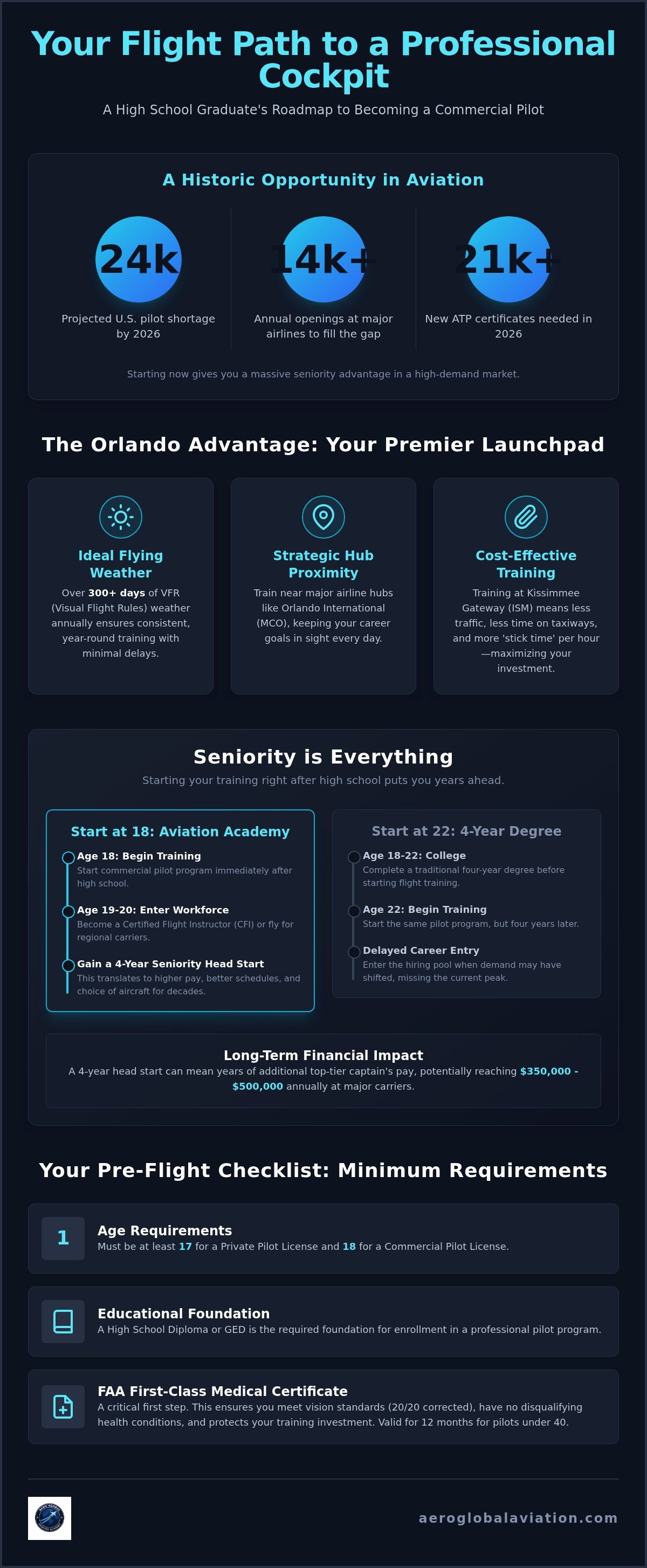
Did you know the U.S. pilot shortage is projected to hit a peak of 24,000 unfilled positions in 2026? This data suggests that starting your pilot training for high school graduates Orlando right now gives you a massive seniority advantage over those waiting for a traditional four-year degree. You likely feel the weight of this decision, perhaps worrying about choosing the wrong training path or getting lost in complex FAA medical requirements. It's natural to feel some uncertainty when the career stakes are this high.
We're here to help you clear the clouds and move forward with purpose. This guide provides a definitive roadmap for your transition from high school graduation to a professional flight deck. You'll discover the essential requirements for enrollment, the functional differences between a Private Pilot License and a Commercial Pilot License, and how structured tracks like the Career Pilot Program or Airline Pilot Elite can accelerate your journey. We'll also explain why Orlando's unique geography and year-round flying weather make it the premier destination to launch your aviation career with total confidence.
Key Takeaways
- Discover why Orlando’s 300+ days of favorable flying weather and proximity to major airline hubs provide an unmatched environment for consistent training progress.
- Identify the essential age and educational milestones required to begin your pilot training for high school graduates Orlando as soon as you receive your diploma.
- Evaluate the timeline and career benefits of an aviation academy versus a four-year degree to find the fastest route to a professional cockpit.
- Learn the critical first steps of booking a Discovery Flight and securing a First Class FAA Medical Certificate to protect your future investment.
- Explore tailored training paths like the Wings Foundation and the Career Pilot Program that provide a structured journey from graduation to commercial certification.
Why Orlando is the Premier Launchpad for High School Graduates in 2026
Orlando is more than a world-class destination; it's the tactical center of the aviation world. Choosing this region for your pilot training for high school graduates Orlando provides what we call the 'Orlando Advantage.' This is characterized by over 300 days of VFR (Visual Flight Rules) weather annually. This climate ensures your training remains consistent, preventing the long gaps in flight hours that often plague students in northern states. Proximity to major airline hubs like Orlando International (MCO) offers a unique psychological edge. You'll see the heavy jets you aspire to fly every single day, keeping your ultimate destination at the forefront of your mind while you build your foundational skills.
The Strategic Advantage of Kissimmee Training
Training at Kissimmee Gateway Airport (ISM) offers a distinct efficiency benefit over larger, congested international airports. At ISM, lower air traffic volume means you spend less time idling on taxiways and more time performing takeoffs and landings. This increased 'stick time' per hour makes your training more cost-effective and skill-intensive. Aero Global Aviation Academy uses this location to provide a welcoming, student-centric environment where you aren't just another student in a queue. Our role as a practical mentor means we focus on your individual progress within a community of local experts who are deeply invested in your success.
Seniority: The Most Important Word in Aviation
In the airline industry, your seniority number determines your schedule, your aircraft, and your salary. Starting your journey at 18 rather than 22 gives you a massive head start that compounds over a forty-year career. 2026 represents a historic entry point for new pilots. Industry data from consulting firm Oliver Wyman projects the U.S. pilot shortage will peak this year with a shortfall of 24,000 pilots. When you begin the pilot certification process immediately after high school, you enter the workforce while major airlines are aggressively hiring to fill over 14,500 annual openings.
The long-term financial impact of reaching a major carrier four years earlier is staggering. It often equates to several years of top-tier captain's pay, which can reach between $350,000 and $500,000 annually at major carriers. By starting your pilot training for high school graduates Orlando now, you aren't just learning to fly. You're securing a prime spot in the hiring queue that will benefit you for decades to come. The current demand for 21,400 new ATP certificates in 2026 against a limited supply makes this the most strategic time to transition from the classroom to the cockpit.
Minimum Requirements: What High School Graduates Need to Start
Transitioning from a high school classroom to a professional flight deck requires more than just passion. You must meet specific regulatory and educational milestones before your first lesson. Meeting the prerequisites for pilot training for high school graduates Orlando is your first real test as an aspiring aviator. You must be at least 17 years old to earn a Private Pilot License and 18 to hold a Commercial Pilot License. A high school diploma or GED serves as the foundational educational requirement for enrollment in professional academies.
Understanding the FAA pilot requirements is essential before you log your first hour. These standards ensure that every pilot in the sky possesses the physical health and mental clarity needed for safe flight operations. Aero Global Aviation Academy focuses on your individual success by guiding you through these administrative steps early in the process.
The FAA First-Class Medical Exam
Securing your medical certificate is a critical first step that you should complete before spending money on flight hours. While the FAA offers three classes of medical certificates, high school graduates pursuing a career should aim for a First-Class certificate immediately. For pilots under age 40, First-Class privileges are valid for 12 calendar months. This exam confirms you meet vision standards, which require 20/20 distant vision in each eye with or without correction, and ensures you have no disqualifying cardiovascular conditions. Obtaining this high level of clearance early prevents the heartbreak of discovering a medical disqualifier after you've already invested in your training.
Documentation and Prerequisites Checklist
You'll need a specific set of documents to begin your pilot training for high school graduates Orlando. This paperwork validates your identity and eligibility to train under federal regulations. Use this checklist to prepare for your enrollment:
- Proof of Citizenship: A valid U.S. Passport or a birth certificate with a government-issued photo ID.
- TSA Authorization: International students must complete the TSA Alien Flight Student Program (AFSP) background check and fingerprinting process.
- Educational Records: Official high school transcripts to verify your graduation status.
- Language Proficiency: You must be able to read, speak, write, and understand the English language fluently.
In 2026, you must apply for your Student Pilot Certificate through the Integrated Airman Certification and Rating Application (IACRA) website, where a flight instructor or FAA representative will verify your identity to initiate your official airman record. Our team acts as a practical mentor to help you navigate these hurdles so you can focus on the sky. If you're ready to see how these requirements fit into a professional timeline, you can explore our Career Pilot Program to start your journey today.
Aviation Academy vs. College Degree: Choosing Your Path
Deciding between a collegiate program and a professional flight academy is often the most stressful choice for families considering pilot training for high school graduates Orlando. While both paths lead to the same flight deck, the timelines and financial outcomes differ significantly. A traditional university program typically requires four years to complete, whereas a dedicated flight academy allows you to reach professional certification in just 12 to 18 months. This speed is a primary driver for graduates who want to capitalize on the current hiring surge.
Think of commercial pilot training as a high value vocational trade rather than a traditional academic pursuit. By choosing the academy path, you avoid four years of tuition inflation and, more importantly, you eliminate the opportunity cost of four years of lost wages. Reaching a regional airline at age 20 instead of 23 means three additional years of earning potential at the end of your career, where senior captain salaries are at their peak.
The Fast-Track Academy Advantage
Professional academies allow you to focus 100% of your energy on flight proficiency. You won't find the distraction of unrelated electives or general education requirements here. This immersive environment accelerates your flight hour accumulation through a highly structured syllabus. It also provides a direct path to becoming a Certified Flight Instructor (CFI). Many of our graduates use this rating to build the 1,500 hours required for airline entry while earning a paycheck, rather than paying for additional flight time.
When a University Degree Makes Sense
Pursuing a degree remains a valid choice for students who want a broader educational foundation or a 'backup' career field in case of medical disqualification. Institutions like Florida Tech's College of Aeronautics offer prestigious programs that can reduce the flight hour requirement for an Airline Transport Pilot (ATP) certificate. Graduates from approved university programs may qualify for a Restricted ATP (R-ATP) at 1,000 or 1,250 hours instead of the standard 1,500. This can be a strategic move if you prefer a traditional campus lifestyle.
You don't have to choose one or the other immediately. Many successful pilots use a 'Degree Later' strategy. They complete their pilot training for high school graduates Orlando at an academy to get hired by an airline as quickly as possible. Once established in their career, they complete their degree online using airline tuition reimbursement programs. This allows you to build seniority and earn a professional income while checking the degree box on your own terms. You can even combine our training with local community college options to earn credits while you fly.
How to Transition from High School to the Flight Deck
Moving from a high school graduation ceremony to a professional cockpit is a structured, step by step process that requires both commitment and clear guidance. Your journey into pilot training for high school graduates Orlando begins with a series of logical milestones designed to build your confidence and technical skill. By following this roadmap, you'll ensure that every hour you spend in the air is a direct investment in your future airline career.
- Step 1: Book a Discovery Flight. This is your chance to confirm that the cockpit is where you belong before committing to a full program.
- Step 2: Secure your FAA Medical Certificate. We recommend obtaining a First Class medical immediately to ensure you meet the long term health standards for airline employment.
- Step 3: Choose your training path. Decide between the Wings Foundation for a PPL focus or the Career Pilot Program for a full transition to commercial flight.
- Step 4: Organize your logistics. Secure your aviation financing and arrange housing in the Kissimmee area to minimize your daily commute.
- Step 5: Launch your training. Begin your formal Ground School curriculum and log your first official flight hours with your instructor.
The Discovery Flight: Your First Real Lesson
An introductory flight lesson in Orlando is much more than a scenic tour. You'll sit in the pilot's seat, participate in the pre flight inspection, and learn how to use the primary flight controls under the watchful eye of a certified instructor. This is your opportunity to evaluate the academy's fleet and the instructor's teaching style. The moment you pull back on the yoke and feel the wings lift you away from the runway, your perspective on the world changes forever. It's the ultimate 'litmus test' for your new career path.
Financing Your Flight Training
Financing is a major consideration for most families, but specialized aviation loans make the process manageable. These financial products are designed to cover the cost of training while offering flexible repayment terms that account for your transition into the workforce. When you're budgeting for your private pilot license florida, you can often structure your payments to match your specific training milestones. Don't forget to research scholarships from organizations like AOPA or EAA, which frequently offer grants specifically for high school graduates entering the field. If you're ready to take the first step toward your new career, contact our admissions team to schedule your discovery flight and discuss your enrollment options today.
The Aero Global Path: From Graduate to Elite Professional
Aero Global Aviation Academy operates as your dedicated partner, moving beyond the role of a traditional school to act as a Practical Mentor for every student. We understand that 18 year olds face unique challenges when entering a high stakes professional environment. Our programs are designed to provide the structure and support necessary to hit every career milestone with precision. When you choose pilot training for high school graduates Orlando, you need a path that balances technical rigor with personal encouragement. For those looking to begin their journey, the Wings Foundation provides the essential Private Pilot License (PPL) foundation, allowing you to master the basics before committing to a full career track.
For students ready for a total career transition, our Career Pilot Program offers a structured journey from your first flight through to your Commercial Pilot License (CPL). This path is designed for efficiency, ensuring you don't waste time on redundant training. If your goal is the captain's seat at a major airline, the Airline Pilot Elite program is our most comprehensive solution. It includes the advanced instructor ratings needed to bridge the gap between graduation and the flight deck. Selecting our academy for your pilot training for high school graduates Orlando means you're following a roadmap built for success in the 2026 hiring market.
Building Hours: The CFI Phase
Most flight schools focus only on the initial licenses, leaving graduates to figure out how to reach the 1,500 hour airline requirement on their own. Our Airline Pilot Elite program intentionally prioritizes instructor certifications because the Certified Flight Instructor (CFI) phase is the most effective way to build professional experience. Teaching others forces you to master aviation concepts at a deeper level, which makes you a significantly safer and more employable pilot. You'll earn a living while building your hours, transforming from a student into a professional mentor yourself while you wait for your airline class date.
Next Steps for 2026 Graduates
The transition from a high school diploma to a professional career is a significant leap, but you don't have to navigate it alone. Preparing for the transition to advanced flight training starts with understanding the specific ratings you'll need for your chosen airline path. We invite you to visit our facilities at the Kissimmee Gateway Airport to see our operations first hand. Seeing our fleet and meeting our instructors in person will give you the confidence that you've chosen the right environment for your growth. Start your aviation journey with Aero Global Aviation Academy today!
Take the First Step Toward Your Professional Flight Deck
Choosing to start your pilot training for high school graduates Orlando immediately after receiving your diploma is a strategic move that sets the foundation for decades of professional success. You've seen how the path from graduation to the flight deck can be completed in as little as 12 to 18 months, providing a significant seniority advantage in a market hungry for new talent. By leveraging the ideal training conditions at our Kissimmee Gateway Airport (ISM) hub, you ensure your progress remains steady and efficient.
Aero Global Aviation Academy acts as your dedicated practical mentor, providing the personalized guidance and full PPL-to-CPL career tracks you need to excel. Don't let the opportunity of the current hiring peak pass you by. Take control of your future and Enroll in the Career Pilot Program at Aero Global Aviation Academy to begin your journey toward the elite professional ranks. The sky isn't just a destination; it's your new workplace. We're ready to help you earn your wings and launch your career with confidence.
Frequently Asked Questions
Can I start flight school at 17 if I haven't graduated high school yet?
You can certainly begin flight lessons at 17 before your graduation, as the FAA allows you to hold a Private Pilot License (PPL) at that age. However, most professional tracks, including our pilot training for high school graduates Orlando, require a diploma or GED for full enrollment into a career program. We recommend starting with the Wings Foundation to build your initial skills while you finish your senior year.
How much does it cost to become a pilot in Orlando after high school?
The total investment varies based on your personal progression and the specific training track you select. While we don't provide fixed tuition costs here, we encourage families to evaluate the value of accelerated training compared to the long-term expense of a traditional degree. Many students manage their journey from student to professional through specialized aviation financing or scholarships specifically designed for young aviators entering the field.
Do airlines still require a 4-year degree in 2026?
In 2026, many major airlines have moved away from strict degree requirements to address the ongoing pilot shortage, prioritizing flight hours and certifications instead. While a degree remains a valuable asset for long-term advancement, many pilots now choose to enter the workforce quickly through a professional academy. You can always complete an online degree later using airline tuition reimbursement programs while you are already earning a professional salary.
How long does the Career Pilot Program take to complete?
Our Career Pilot Program is designed for maximum efficiency and typically takes between 12 and 18 months to complete. This timeline assumes you are training consistently and taking advantage of the favorable Orlando flying weather. This accelerated pace allows you to transition from a high school graduate to a commercial pilot much faster than a traditional collegiate route, giving you a significant head start on airline seniority.
Is Orlando or Kissimmee better for student pilot training?
Kissimmee Gateway Airport (ISM) is generally superior for student pilots because it provides a professional environment without the heavy air traffic congestion found at Orlando International (MCO). You'll spend less time waiting on the taxiway and more time practicing essential maneuvers in the air. This efficiency is a core benefit of our pilot training for high school graduates Orlando, ensuring every training hour is used effectively.
What is the difference between a Part 61 and Part 141 flight school?
Part 141 schools follow a more rigid, FAA-approved syllabus that can allow you to earn a Commercial Pilot License with fewer total hours, such as 190 instead of 250. Part 61 programs offer more flexibility for students who need to move at a different pace. We act as a practical mentor to help you decide which regulatory path aligns best with your specific career goals and your desired timeline for employment.
Can I get a job immediately after finishing the Airline Pilot Elite program?
The Airline Pilot Elite program qualifies you for advanced instructor ratings, which are the primary gateway to your first professional aviation job. Most graduates immediately begin working as flight instructors to build experience. This role allows you to earn a living while accumulating the 1,500 flight hours required for major airline employment, effectively bridging the gap between your initial training and your ultimate destination on a professional flight deck.
What happens if I fail my FAA medical exam?
If you fail your FAA medical exam, you should consult an Aviation Medical Examiner (AME) regarding a "Special Issuance" or a deferral process. This is why we emphasize securing a First-Class Medical Certificate before you invest in flight training. Understanding your medical eligibility early protects your future investment and ensures you can safely pursue a long-term career in the cockpit without discovering a disqualifying condition after you've already started.


