
What if spending four years and over $300,000 on a university campus actually delays your first airline paycheck? It's a question many aspiring pilots are asking in 2026: is an aviation degree worth it in Florida when the industry demands speed and skill above all else? You likely feel the pressure to choose between the perceived safety of a degree and the urgent need to start your career. With the FAA now requiring strictly merit-based hiring through OpSpec A134, the focus has shifted from where you went to school to how well you can actually fly.
We understand the anxiety that comes with massive student loans and the fear of being stuck in a classroom while others are already building hours. Our goal is to help you discover the most efficient path to a professional pilot career by comparing Florida aviation degrees with accelerated academy training. In this guide, we'll break down the latest airline requirements, compare training timelines, and show you how to leverage Florida's 300 days of sunshine to reach the seniority list faster. You'll gain the clarity needed to minimize costs and maximize your time in the air while deciding if the R-ATP hour reduction is worth the four-year wait.
Key Takeaways
- Understand the financial and career implications to decide if an aviation degree is worth it in Florida compared to accelerated academy training.
- Explore the 2026 FAA merit-based hiring regulations and how they impact your ability to land a job at major airlines.
- Compare the four-year university commitment against intensive tracks that can get you airline-ready in less than half the time.
- Learn how to maximize your flight hours by leveraging Florida's 300+ flying days and professional-grade training environments.
- Evaluate advanced credentials like the Airline Pilot Elite program to see how they serve as a powerful alternative to traditional academic degrees.
The Aviation Degree vs. Flight School Dilemma in 2026
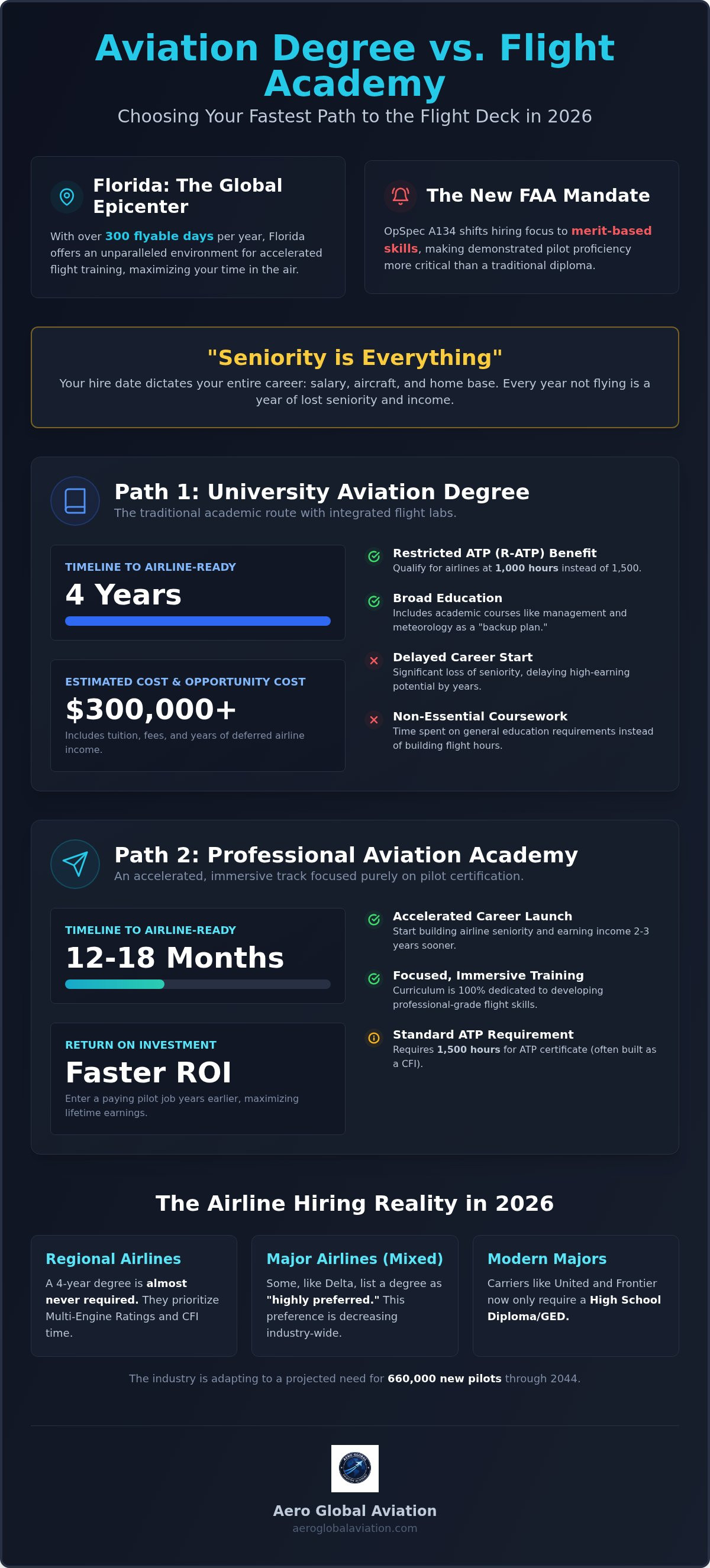
Florida stands as the global epicenter for flight training, offering a strategic advantage that few other locations can match. With over 300 flyable days every year and a robust infrastructure of airports, it's the natural place to start your journey. However, many students feel torn between the traditional university experience and the intensity of a flight academy. When asking is an aviation degree worth it in Florida, you must consider the "Seniority is Everything" rule. In the airline industry, your hire date dictates your entire life, from your monthly salary and the aircraft you fly to your ability to choose your home base. Every year spent in a classroom instead of a cockpit is a year of lost seniority at the major airlines.
This leads to the concept of opportunity cost. While a degree offers a broad education, the four-year timeline means you're deferring high-level airline wages. In 2026, with the FAA implementing merit-based hiring under OpSpec A134, your ability to demonstrate professional-grade skills is more critical than a college diploma. Choosing the right path involves weighing the long-term academic "backup plan" against the immediate goal of reaching the flight deck as quickly as possible.
What is an Aviation Degree Program?
A university-based program typically follows a Bachelor of Science in Aviation curriculum. These are often Part 141 schools that integrate flight labs with academic courses like aviation management, meteorology, and general education requirements. The primary benefit of this path is the Restricted ATP (R-ATP) certificate. This allows graduates from qualifying universities to enter the airlines with 1,000 flight hours instead of the standard 1,500. While this reduction is valuable, it comes at the price of four years of tuition and non-aviation coursework that doesn't directly improve your stick-and-rudder skills.
What is a Professional Aviation Academy?
A professional academy focuses exclusively on your transformation into a commercial pilot. Our Career Pilot Program is a prime example of this model, designed to move you from zero experience to a commercial certificate in just 12 to 18 months. This path prioritizes FAA pilot certification requirements through immersive, daily training. By stripping away elective classes, you focus entirely on the technical proficiency and procedural discipline required by modern carriers. For those wondering is an aviation degree worth it in Florida, the academy route offers a faster return on investment by getting you into a paying pilot job years earlier than the university track.
Do Airlines Still Require a Degree in 2026?
The industry's approach to hiring has undergone a radical transformation. Airlines are currently facing a massive demand for new talent, with Boeing projecting a global need for 660,000 new pilots through 2044. This pressure has led many carriers to re-evaluate their entry requirements. Many prospective students ask, is an aviation degree worth it in Florida when major carriers are dropping traditional requirements in favor of technical proficiency. The positive job outlook for airline pilots reflects a market where flight hours and merit-based performance are the ultimate currency.
The Regional Airline Perspective
Regional airlines serve as the essential starting point for most commercial careers. In 2026, these carriers almost never require a four-year degree for First Officer positions. They prioritize candidates who possess a Multi-Engine Rating and have already logged significant time as a Certified Flight Instructor (CFI). By entering the regional workforce early, you start building seniority immediately. This seniority is the single most important factor for your future career progression and pay scale. If you're looking for the fastest path to a paycheck, focusing on ratings rather than a degree is often the smarter move. If you're ready to bypass the classroom, you can begin your journey with us today.
The Major Airline Reality
Major airlines like Delta still list a four-year degree as "highly preferred," but others have moved in a different direction. United Airlines and Frontier Airlines now only require a high school diploma or GED equivalent for their applicants. This shift is driven by the urgent need to fill cockpits as older pilots reach mandatory retirement age. Many pilots now use flow-through programs to reach the majors. This allows you to start at a regional partner and "flow" into a major carrier based on your performance and time served, regardless of your degree status. For those wondering is an aviation degree worth it in Florida, it's clear that professional training often provides a more direct route to the flight deck. In 2026, hiring minimums are the baseline FAA certifications and flight hour thresholds required for a pilot to be legally eligible for an airline interview.
Comparing Costs, Timelines, and ROI
Deciding how to allocate your training budget is perhaps the most significant choice you'll make in your early career. When you ask, is an aviation degree worth it in Florida, you have to look beyond the sticker price of tuition. Traditional universities bundle flight fees with academic costs, room, board, and campus amenities. These hidden expenses can inflate your debt without adding a single hour to your logbook. By choosing a professional academy, you ensure your investment is laser-focused on Commercial Pilot Training and the technical skills that actually matter to airline recruiters. Every dollar you spend should move you closer to a paying cockpit seat.
Timeline to 1,500 Hours
The "Time-to-Money" factor is the ultimate decider for many aspiring aviators. Academy students typically reach the flight deck readiness stage in 12 to 18 months, while degree-seeking students are often still in their sophomore year. Our training environment in Kissimmee is a strategic asset, offering 300 plus flyable days annually. This consistency prevents the seasonal delays common in other regions, allowing you to build hours at a relentless pace. The Airline Pilot Elite program is specifically structured to accelerate this process, moving you through ratings with professional-grade efficiency that matches airline training environments. While university students are studying for midterms, you could be building real-world experience as a flight instructor.
The Financial Gap
Comparing the long-term debt of a four-year private institution to a focused flight academy reveals a stark contrast. University students often graduate with substantial loans that cover non-aviation requirements, whereas academy students can often utilize modular training to pay as they progress. This approach keeps your financial footprint smaller and more manageable. It's also important to consider the massive opportunity cost of those extra years in school. Entering the workforce 2.5 years earlier means you start earning a professional salary and climbing the seniority ladder sooner. When you factor in the lost wages while sitting in a university classroom, the "worth" of that degree becomes harder to justify. A single year of a major airline first officer's salary can often completely offset the total cost of your academy training, making the faster path the more logical financial choice for most career-minded pilots.
Choosing the Right Path for Your Career Goals
Choosing your training path requires a cold, hard look at your personal timeline and ultimate career destination. If you are a career-changer over the age of 30, the question of whether is an aviation degree worth it in Florida becomes a matter of simple math. Every year you spend in a university classroom is a year of top-tier airline salary you will never recover at the end of your career. Because the FAA mandates retirement at age 65, starting your career at 35 versus 39 can represent a difference of millions in lifetime earnings. For those starting later, the academy path isn't just a choice; it's a strategic necessity to maximize your remaining years in the cockpit.
You should also consider the "back-up plan" myth. Many students believe an aviation degree serves as a safety net if they ever lose their FAA medical certificate. In reality, a degree in Aeronautical Science or Aviation Management is so specialized that it often provides less flexibility in the general job market than a standard business or technology degree. If your medical eligibility is a concern, you might be better served by earning a degree in a different field online while you focus your physical energy on accelerated flight training. This approach gives you a true secondary skill set without delaying your progress toward the flight deck.
When the Degree Makes Sense
A university path remains a strong option if you aspire to work in upper management at a major carrier or hold a federal role within the FAA. These positions often require a bachelor's degree as a baseline for promotion. Additionally, veterans utilizing the GI Bill often find that university-affiliated programs offer the most seamless way to apply their benefits toward flight training. Finally, for younger students who value the traditional college experience, the four-year commitment provides a lifestyle that a dedicated academy cannot replicate. It's a path that prioritizes the journey as much as the destination.
When the Academy is the Clear Winner
If your primary goal is to reach the airlines as fast as humanly possible, the academy model is the undisputed champion. It provides a high-intensity, immersive environment where you can focus entirely on Advanced Flight Training without the distraction of unrelated electives. This focus is essential for mastering the procedural discipline required by modern airlines. The flexibility of Florida's training environment allows academy students to fly multiple times a day, building proficiency and hours at a rate that university schedules simply can't match. If you're ready to take the next step toward your professional goals, you can apply to our pilot programs and start your journey today.
The Aero Global Advantage: Professional Training in Kissimmee
Kissimmee, Orlando isn't just a place to fly; it's a strategic launchpad for your career. When you're weighing if is an aviation degree worth it in Florida, you have to look at the environment where you'll spend your time. Unlike a university campus that might be miles from a primary airport, our academy is situated in the heart of one of the busiest aviation corridors in the world. This proximity gives you an immediate advantage. You'll learn to navigate complex airspace and communicate with professional controllers from your very first flight. This immersion is a core part of our Airline Pilot Elite program, which we've designed as the definitive degree alternative. It moves beyond the theory of a classroom and focuses on the high-stakes reality of professional flight.
Structured for Success
Our programs are built to mirror the rhythm and discipline of a major airline training department. We focus on "Flight Deck Readiness" by treating every lesson as a professional briefing. The transition from your Private Pilot License Florida through to your Commercial ratings is seamless and structured. We don't just teach you how to pass a checkride; we mentor you on how to manage a crew, handle complex systems, and make sound aeronautical decisions. This mentorship is delivered by active and former professional pilots who understand the industry's current demands, providing a level of insight that an academic lecture simply can't match.
The Florida Training Edge
The geographic advantage of Kissimmee is a primary reason why students from around the world choose this location. With over 300 days of VFR weather annually, your training schedule remains consistent and predictable. You won't find yourself grounded for weeks at a time by winter storms or persistent low ceilings. This reliability allows you to maintain a steady momentum that university schedules, with their breaks and semesters, often lack.
- Maximize your training hours with nearly year-round sunshine.
- Master radio communications in the busy Orlando terminal area.
- Train in professional-grade facilities designed for career-track students.
- Build a network within a community of focused, like-minded aviators in the heart of Florida aviation.
When you consider the total cost and time involved, you'll see why many choose the academy route. If you're still asking if is an aviation degree worth it in Florida, come see the difference for yourself. Booking a discovery flight is the best way to experience our professional environment firsthand and speak with our mentors about your specific goals. It's time to stop wondering and start flying toward your future.
Take Command of Your Aviation Future
Deciding between a traditional university and a professional academy defines your career trajectory and financial future. While a degree offers academic depth, the current industry shift toward merit-based hiring makes speed and technical proficiency your greatest assets. You've seen how seniority dictates your lifestyle and income, making the 12 to 18 month academy timeline a powerful alternative to the four-year university track. When evaluating if is an aviation degree worth it in Florida, consider the strategic advantage of 300 plus flying days per year in Orlando and the ability to reach the flight deck years ahead of your peers.
Our structured PPL to CPL tracks provide an airline-style training environment that prioritizes professional discipline from day one. By focusing on your ratings rather than unrelated electives, you minimize debt and maximize your earning potential in a high-demand market. The sky is waiting for those ready to take the most direct path to the cockpit.
Ready to start your career? Explore the Aero Global Career Pilot Program today.
We're here to mentor you every step of the way as you transform your passion for flight into a rewarding professional reality. Your journey to the flight deck starts with a single, decisive step.
Frequently Asked Questions
Do major airlines require a bachelor's degree in 2026?
No, most major airlines do not strictly require a bachelor's degree in 2026. While carriers like Delta still list it as highly preferred, others like United and Frontier have removed the requirement. The FAA's shift toward merit-based hiring means airlines prioritize your flight record and proficiency. If you're wondering is an aviation degree worth it in Florida, remember that professional certification often matters more than a diploma in today's pilot-starved market.
Is an aviation degree better than a degree in another field for a pilot?
Not necessarily. While an aviation degree provides specialized knowledge, a degree in a field like business or technology offers a more robust safety net. If you ever lose your medical certificate, a non-aviation degree gives you broader career options. Many pilots choose to pursue accelerated training at our Kissimmee academy while completing a different degree online. This strategy allows you to diversify your skills while ensuring you reach the flight deck quickly.
How much faster is a flight academy than an aviation degree?
A flight academy is significantly faster, often taking just 12 to 18 months to reach commercial certification. In contrast, a university program typically requires four years of academic study alongside flight labs. By choosing a dedicated academy in Orlando, you can reach the 1,500-hour milestone while university students are still in their sophomore year. This speed allows you to start earning a professional salary and building seniority much sooner than the academic route.
Can I get a degree online while attending a flight academy?
Yes, many of our students successfully pursue online degrees while training at our Kissimmee facility. This hybrid approach allows you to gain academic credentials without the slow pace of a traditional campus schedule. You can focus your physical energy on daily flight training in Florida's excellent weather while completing coursework during your downtime. It's a strategic way to build a professional resume that includes both high flight hours and a college degree.
Does a degree help if I lose my FAA medical certificate?
A degree only helps if it is in a field with broad job market demand. An Aeronautical Science degree is highly specialized, which can make it difficult to transition into a non-aviation role. If medical eligibility is a concern, a degree in business, communications, or IT provides a much stronger safety net. Most pilots find that professional training combined with a versatile degree offers the best protection for their future career stability.
What is the R-ATP and does it make a degree worth it?
The Restricted Airline Transport Pilot (R-ATP) certificate allows university graduates to enter the airlines with 1,000 or 1,250 flight hours instead of 1,500. Whether this makes a degree worth it depends on your career timeline. While you save 500 hours of building time, you spend three extra years in a university classroom. When asking is an aviation degree worth it in Florida, remember that the academy path gets you to the seniority list much faster.
Are flight schools in Florida more expensive than elsewhere?
Flight schools in Florida are highly competitive, and the region's weather often makes training more cost-effective. With over 300 flyable days per year in Kissimmee, you avoid the expensive delays caused by winter weather in northern states. This efficiency means you spend less on housing and recurring training costs. You'll find that the ability to fly consistently helps you reach proficiency faster, which ultimately saves you money on your total certification journey.
Can I get financial aid for a flight academy in Kissimmee?
Yes, there are several ways to fund your training at our Kissimmee academy. While traditional federal student loans are often reserved for universities, many flight students utilize private aviation loans or industry scholarships. We encourage you to explore local Florida aviation grants and national organizations that support aspiring pilots. Our team can guide you toward financing partners that understand the unique needs of students in professional pilot programs.


