
What if you could launch a lifelong aviation career from your first solo to your final airline captaincy without ever crossing the state line? Florida is a self-contained aviation ecosystem, yet many aspiring aviators feel stuck before they even start. You might feel overwhelmed by the 1,500-hour airline requirement or find yourself confused by the maze of FAA certifications required for different roles. It's completely normal to feel unsure which niche fits your personal goals, but the Sunshine State offers a unique advantage for those ready to take the controls.
In this article, we'll demystify the market and explore seven major types of pilot jobs in Florida that are hiring today. You'll gain a clear understanding of the specific ratings needed for various sectors, from traditional commercial roles to the cutting-edge world of advanced air mobility. Whether you're starting with your Private Pilot License or aiming for a seat in a corporate jet, we'll provide the roadmap you need to transition from a student pilot to a confident professional on the flight deck. Let's find the path that gets you into the air and keeps you there.
Key Takeaways
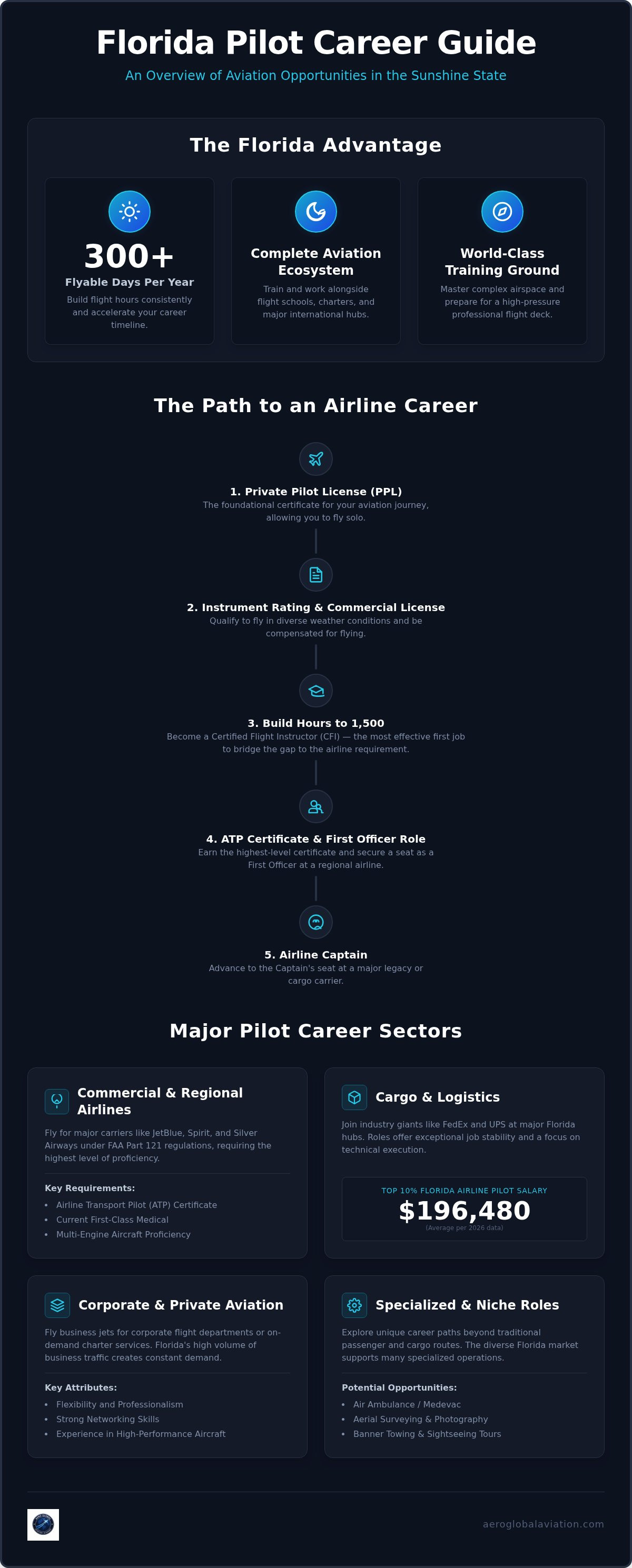
- Discover why Florida offers a strategic advantage for your training with over 300 flyable days per year, allowing you to reach your career milestones faster.
- Explore the diverse types of pilot jobs in Florida, ranging from major regional airlines and cargo carriers to exclusive corporate flight departments.
- Learn how becoming a Certified Flight Instructor serves as the most effective first job to bridge the gap toward the 1,500-hour airline requirement.
- Understand how structured training paths like the Career Pilot Program provide a clear, professional roadmap from your first solo to a commercial flight deck.
Why Florida is the Global Hub for Pilot Careers
Florida isn't just a vacation destination; it's the definitive heartbeat of the global aviation industry. The state hosts more flight training and aviation activity than almost anywhere else on the planet, creating a self-contained ecosystem where you can grow from a novice to a captain. This density is a massive benefit for anyone exploring the different types of pilot jobs in Florida. You'll see every facet of the industry in action, from flight schools and local charters to massive international hubs in Orlando, Miami, and Tampa that serve as gateways to the world. By training in this environment, you're immersing yourself in a professional culture from day one.
The Economic Impact of Florida Aviation
Central Florida serves as a powerful magnet for aerospace and defense contractors, which brings a high volume of sophisticated technology to our local skies. At airports like Kissimmee Gateway (KISM), the steady flow of business jet traffic demonstrates the constant demand for skilled crews. This proximity is a strategic asset for your career. Local networking in Florida often leads to first officer placements because you're training in the same facilities where major corporate flight departments operate. When you look at the history of aviation in Florida, you see a legacy of innovation that continues to drive job growth and creates a stable foundation for your professional future.
Weather and Infrastructure: Training Where You Will Work
Our climate provides the most tangible advantage for your career timeline. With over 300 flyable days per year, you can build hours with a consistency that northern states simply can't match. This year-round access is a game changer when you're working toward the 1,500-hour airline requirement. Beyond the weather, the complexity of Florida's airspace serves as a world-class training ground. Navigating these busy corridors ensures you're ready for the high-pressure environment of a professional flight deck. It's the ideal place to begin your airline pilot career path. At Aero Global Aviation Academy in Kissimmee, we place you at the center of this activity, providing the mentorship you need to thrive in a competitive market.
Commercial and Regional Airline Pilot Roles
Securing a seat on a commercial flight deck is the ultimate goal for many aviators. Florida serves as a primary operations base for major carriers like JetBlue, Spirit, and Silver Airways, offering some of the most prestigious types of pilot jobs in Florida. These roles typically fall under FAA Part 121 regulations, requiring a high level of technical proficiency and professional discipline. To join these ranks, you'll need your Airline Transport Pilot (ATP) certificate, a current first-class medical, and a solid foundation in multi-engine aircraft operations. Florida's status as the top state for aviation manufacturing ensures that the supporting infrastructure for these carriers remains world-class, creating a stable environment for your long-term career.
The Path to the Major Airlines
Transitioning from a student to a major airline captain is a structured journey. It begins with earning your Commercial Pilot License (CPL). Once certified, most pilots spend time building the required flight hours through instruction or specialized niche roles. After reaching the 1,500-hour milestone, the traditional next step is a First Officer position at a regional airline. These regional carriers act as essential training grounds, allowing you to gain experience in high-performance jets before you eventually flow through to major legacy carriers. If you're ready to start this progression, our Career Pilot Program provides the exact training milestones you need to stay on track.
Cargo and Logistics Operations in Florida
The cargo sector offers a unique and highly rewarding alternative to passenger airlines. Giants like FedEx and UPS maintain significant operations at major Florida logistics hubs, where pilots enjoy high pay scales and exceptional job stability. While the lifestyle often involves night-flying schedules, many aviators prefer the focus on technical execution and the absence of passenger management. The top 10% of airline pilots in Florida earn an average of $196,480 according to September 2026 data, and cargo roles are a significant driver of these high earnings. Success in this sector requires specialized commercial pilot training to master the heavy aircraft and complex logistics involved in global freight transport.
Corporate, Charter, and Private Aviation Jobs
While the airline path is the most well-known, private aviation offers some of the most dynamic and personally rewarding types of pilot jobs in Florida. The state's unique position as a global business hub means that many Fortune 500 companies maintain dedicated corporate flight departments here. In these roles, you aren't just a number on a seniority list; you're a vital part of a high-functioning team. You might find yourself flying a King Air for a regional executive or a Gulfstream for an international CEO, often visiting smaller, more exclusive airports that commercial airliners can't reach.
Florida's business environment is a primary driver for this sector. According to research on Florida's aviation and aerospace industry, the state's infrastructure supports a massive volume of private and corporate traffic. This creates a wealth of opportunities in on-demand charters (Part 135) and fractional ownership programs like NetJets or Flexjet. Both of these companies maintain significant crew bases in the state, offering pilots the chance to live in Florida while flying a diverse fleet of modern aircraft across the country and beyond.
Corporate vs. Airline Careers: Which is Right for You?
Choosing between these two paths often comes down to your preferred lifestyle and career goals. While airlines use rigid, seniority-based bidding for schedules and pay, corporate roles often rely on performance-based advancement. Private aviation also demands a higher level of customer service. You're frequently interacting directly with passengers, managing on-board catering, and coordinating ground logistics. The variety of aircraft is another major draw. You could spend your career mastering everything from light turboprops to ultra-long-range jets, providing a level of technical variety that few airline roles can match.
Air Ambulance and Emergency Medical Services (EMS)
Another critical and high-stakes sector within Florida's private aviation landscape is Emergency Medical Services (EMS). Air ambulance pilots perform life-saving work, transporting patients between specialized medical centers or responding to urgent medical needs. These roles are incredibly demanding and require exceptional precision. You'll need high instrument proficiency and, in many cases, experience with specialized equipment to handle the pressure of critical care transport. Completing advanced flight training is an essential prerequisite for these positions. It ensures you have the technical mastery required to operate safely in the challenging, time-sensitive environments that define the EMS sector.
Specialized and Niche Pilot Opportunities
While the heavy jets often grab the headlines, the true backbone of the state's aviation activity is found in specialized roles. These types of pilot jobs in Florida provide essential services that keep the state's economy and environment thriving. For low-hour pilots, classic coastal jobs like banner towing offer a unique way to gain stick-and-rudder experience while enjoying the Atlantic breeze. Similarly, aerial photography and mapping roles support Florida's massive real estate and environmental sectors, requiring precise flight paths and technical coordination. In the heart of the state, agricultural pilots perform vital crop dusting for the citrus and farming regions, a role that demands exceptional low-level maneuvering skills and a deep understanding of local geography. Exploring these niches helps you find the perfect fit for your lifestyle while you build the professional experience required for higher certifications.
Becoming a Flight Instructor in Kissimmee
If you're looking for the most reliable way to build professional experience, becoming a Certified Flight Instructor (CFI) is the gold standard. Teaching others to fly reinforces your own knowledge and builds the decision-making skills required for a long-term career. At our academy, we emphasize a Practical Mentor mindset. You aren't just an instructor; you're a guide for the next generation of aviators. Our Airline Pilot Elite program specifically integrates instructor ratings to ensure you have a clear path to employment as soon as you finish your training. It's the most effective way to reach your hour-building goals while staying rooted in the vibrant Orlando aviation market.
Government and Law Enforcement Aviation
For those driven by a sense of service, government aviation offers a stable and rewarding career path. Agencies like the Florida Fish and Wildlife (FWC) and various local Sheriff offices rely on pilots for search and rescue, surveillance, and environmental protection. These roles often require tactical flight training and the ability to operate in high-pressure situations. Unlike some commercial sectors, government service provides unique benefits, including robust pensions, specialized training, and a clear sense of purpose. It's a path that allows you to use your skills to protect the natural beauty and safety of the state you call home.
Ready to turn your passion into a professional reality? Apply for our Career Pilot Program and start building the hours you need for a successful future in Florida skies.
How to Launch Your Florida Pilot Career at Aero Global
Launching a successful aviation career requires more than just passion; it requires a structured roadmap designed for the modern industry. At Aero Global Aviation Academy, we've built our training programs to bridge the gap between your first solo and the diverse types of pilot jobs in Florida we've explored. Our facility at Kissimmee Gateway Airport places you in the heart of the world's busiest aviation corridor, where you'll train alongside professional traffic from day one. This immersive environment ensures that you don't just learn to fly; you learn to operate with the discipline and precision required by major airlines and corporate flight departments.
Our curriculum is divided into clear, manageable milestones that respect your time and professional goals. We start with the Wings Foundation, which provides the essential Private Pilot License (PPL) base. From there, you can transition into our Career Pilot Program, a structured path that takes you from your PPL through to Commercial Pilot certification. For those who want the most comprehensive preparation possible, our Airline Pilot Elite program includes advanced instructor ratings, giving you a direct path to employment and hour-building in the local Orlando market. We act as your practical mentor, ensuring every hour in the cockpit is a step toward your ultimate destination.
Choosing the Right Program for Your Goals
Matching your training to your career aspirations is the first step toward success. If you're a hobbyist or simply testing the waters, the Wings Foundation is the perfect entry point to experience the thrill of flight. For those aiming for the fast-paced world of charter or corporate aviation, the Career Pilot Program offers the technical depth needed to master multi-engine operations and professional standards. If your eyes are set on the major airlines, we recommend the Airline Pilot Elite track. This program is specifically designed to meet the high-volume hiring needs of 2026 by providing the instructor certifications that allow you to reach the 1,500-hour mark with confidence and skill.
Next Steps: From Discovery Flight to First Officer
Your journey begins with a single, decisive action. We invite you to book a discovery flight at our Kissimmee facility, where you'll get hands-on experience in a modern G1000-equipped cockpit. This isn't just a ride; it's your first professional assessment. Following your flight, you'll consult with our mentors to build a personalized training timeline tailored to the current hiring hubs in Florida. We'll help you navigate the medical requirements and certification steps to ensure your path is as efficient as possible. To prepare for your visit, read our guide on how to get your private pilot license in Florida for a detailed look at the first tactical step in your new career. Start your engines today and claim your place in the Florida skies.
Take Command of Your Future in the Skies
Florida offers an unparalleled environment for aspiring aviators, providing a direct pipeline into the most rewarding types of pilot jobs in Florida. Whether you aim for the captain’s seat at a major airline or the personalized service of a corporate flight department, the state’s infrastructure and constant demand create a stable foundation for your professional life. You now have a clear roadmap from your first discovery flight to achieving the 1,500-hour milestone as a certified instructor.
At Aero Global Aviation Academy, we’re ready to help you navigate this transition with precision and confidence. Our Kissimmee-based facility leverages over 300 flyable days per year to accelerate your training timeline, while our professional G1000-equipped fleet ensures you’re learning on modern technology. From the initial steps of our Wings Foundation to the comprehensive Airline Pilot Elite track, we provide the structured path you need to succeed. The flight deck is within your reach, and the journey starts with a single decision to move forward.
Start Your Aviation Journey: Explore Our Career Pilot Programs and claim your place in the cockpit today. We look forward to seeing you in the skies.
Frequently Asked Questions
What is the most common entry-level pilot job in Florida?
The most common entry-level role is a Certified Flight Instructor (CFI). This position allows you to build the flight hours required for major airlines while mentoring new students. In the Orlando area, CFIs are in high demand due to the density of flight schools. Our Airline Pilot Elite program is specifically designed to transition you into this role as your first professional destination, turning your training into a paycheck while you gain experience.
How many flight hours do I need to work for a regional airline in Florida?
To fly for a regional airline under Part 121 regulations, you typically need 1,500 total flight hours to obtain your Airline Transport Pilot (ATP) certificate. However, students who train through structured FAA Part 141 programs may qualify for a Restricted ATP with fewer hours. Reaching this milestone is a major goal for those pursuing various types of pilot jobs in Florida, as regional carriers serve as the primary stepping stone to major legacy airlines.
Can I work as a pilot in Florida with only a Commercial Pilot License?
Yes, you can work as a professional pilot with only a Commercial Pilot License (CPL). While you won't be eligible for major airlines yet, a CPL allows you to fly for compensation in roles such as banner towing, aerial photography, or as a co-pilot for certain charter operations. This certification is the core of our Career Pilot Program, providing the legal foundation to start earning a salary while you continue building hours toward your ultimate career goals.
Are there pilot jobs in Florida that don’t require 1,500 hours?
Many rewarding opportunities exist for pilots who haven't yet reached the 1,500-hour mark. These include flight instruction, aerial surveying, and banner towing along the Florida coast. Additionally, some Part 135 on-demand charter companies hire first officers with as few as 500 to 800 hours. These roles are excellent for gaining real-world experience and technical proficiency while working toward your long-term career goals in the Sunshine State. CFIs remain the most consistent and effective hour-builders.
What is the difference between flying for an airline and a charter company in Florida?
The primary difference lies in the lifestyle and regulation. Airlines operate under Part 121 with rigid, seniority-based schedules and fixed routes. Charter companies operate under Part 135, offering more variety in destinations and a performance-based environment. Charter pilots often interact directly with high-profile clients and manage more of the ground logistics. Both paths offer competitive salaries, but charter flying provides a more dynamic, less predictable day-to-day experience that many pilots find personally rewarding and technically challenging.
How much do entry-level pilots make in the Orlando area?
Entry-level pilots in the Orlando area, particularly flight instructors, can expect to earn between $40,000 and $60,000 annually depending on their flight volume. As you progress to regional airlines or cargo roles, salaries increase significantly. Current job postings for various types of pilot jobs in Florida show a broad range from $75,000 to over $285,000 for experienced captains. Starting in a high-activity hub like Kissimmee maximizes your earning potential through consistent year-round flying.
Do I need a college degree to get a pilot job in Florida in 2026?
In 2026, a college degree is not a strict FAA requirement for obtaining your pilot certificates or working for regional airlines. While some major legacy carriers still prefer a four-year degree, many have removed it as a mandatory prerequisite to address the global pilot shortage. Focusing on high-quality technical training and building your flight hours is currently the most effective way to secure a position on a professional flight deck and start your aviation career.
Is Kissimmee a good place to start a pilot career?
Kissimmee is an ideal launchpad for your aviation career. Located at the center of Florida's busiest aviation corridor, Kissimmee Gateway Airport (KISM) offers a professional environment with over 300 flyable days per year. This allows you to complete your training faster than in most other regions. Training here provides immediate access to networking opportunities with the corporate and charter operators that call Central Florida home, giving you a distinct strategic advantage as you enter the market.


