
You already hold your Private Pilot License, which means you've proven you can fly. But here's the question that separates hobbyists from professionals: do you actually know the precise steps standing between your PPL and a paycheck in the cockpit? Understanding the PPL to CPL training requirements in Florida is less about memorizing a checklist and more about making smart, strategic decisions that accelerate your entire career trajectory.
If you're feeling overwhelmed by the Part 61 versus Part 141 debate, unsure how to efficiently build your 250 hours without burning through your budget, or simply unclear about which structured program gives you the strongest foundation, you're not alone. These are the exact concerns that hold talented pilots back from taking the next step.
This guide cuts through that confusion. You'll walk away with a clear, step-by-step roadmap from PPL to CPL, a practical understanding of how Florida's year-round flying conditions and high-tempo airspace give you a genuine training advantage, and the confidence to choose a career pilot program built around your professional goals. Let's map out your path forward.
Key Takeaways
- Mastering the PPL to CPL training requirements in Florida means understanding not just the FAA's 250-hour milestone, but the strategic decisions that get you there faster and more affordably.
- Your Second-Class Medical Certificate is the non-negotiable foundation of your commercial career — securing it early protects your entire investment in training.
- Training near Kissimmee Gateway Airport (KISM) places you inside one of the most complex and high-traffic airspace corridors in the country, giving you a competitive edge that flight hours alone can't replicate.
- Smart hour-building strategies — including Safety Pilot arrangements and structured cross-country planning — can significantly reduce the cost of reaching your commercial minimums without sacrificing quality.
- A structured program like Aero Global Academy's Career Pilot Program offers a seamless, professionally guided path from your existing PPL to a commercial certificate built for real-world employment.
Bridge to Professionalism: PPL to CPL Transition
Your PPL proved you can fly. Your Commercial Pilot License will prove you can be trusted to fly others. That distinction matters more than most new pilots initially realize, and it's the foundation of everything that follows in a professional aviation career.
A Commercial Pilot Licence overview makes clear that the CPL isn't simply a PPL with more hours attached. It's a fundamentally different credential, one that grants you the legal authority to act as Pilot-in-Command for compensation or hire. That single privilege is what opens the door to a paying career in the cockpit, and it's why understanding the PPL to CPL training requirements in Florida is worth treating as a serious professional investment, not just a box-ticking exercise.
Privileges of a Commercial Pilot
With a CPL in hand, your career options expand considerably. You can fly aerial tours over theme parks and coastlines, operate charter flights for corporate clients, move time-sensitive cargo, or work as a banner tow pilot building hours toward bigger goals. Each of these roles pays. Each of them also feeds directly into the airline pilot career path, where the CPL serves as a non-negotiable prerequisite for the ATP certificate that major carriers require.
- Aerial tours and sightseeing operations — a common first commercial role in Florida's tourism-heavy market
- Corporate and charter flight — higher earning potential with instrument and multi-engine add-ons
- Cargo and utility operations — consistent hour-building with real-world operational complexity
The Mindset of a Professional Pilot
This is where competitors often miss the point entirely. A CPL isn't just about accumulating 250 hours and passing a checkride. It demands a genuine shift in how you think about flying. Recreational pilots manage risk for themselves. Commercial pilots manage risk for passengers, employers, and the public. That's a heavier responsibility, and it shows up in the training.
You'll master precision maneuvers like chandelles, lazy eights, and steep spirals, not because they're practical in daily operations, but because they build the fine motor control and situational awareness that define a professional standard. Cross-country missions become complex logistical exercises rather than scenic flights. Weather decision-making carries real consequences.
Florida's aviation environment accelerates this maturation. The year-round flying conditions and the high-density airspace around Kissimmee and Orlando put you in genuinely demanding operational scenarios from early in your training, giving you the kind of experience that hours in quieter airspace simply can't replicate. That's a competitive advantage the 2026 job market will recognize.
Core FAA Requirements and Eligibility for CPL in Florida
Before you log a single hour toward your commercial certificate, three baseline eligibility requirements must be in place. You need to be at least 18 years old, demonstrate English proficiency sufficient for radio communications and written tests, and hold a valid medical certificate. These aren't bureaucratic formalities. They're the structural pillars your entire professional career rests on, and one of them deserves far more attention than most candidates give it.
Your Medical Certificate: The Non-Negotiable Foundation
A Second-Class Medical Certificate is required to exercise commercial pilot privileges. Unlike the Third-Class certificate that covered your PPL flying, the Second-Class standard is more rigorous, particularly around vision, cardiovascular health, and neurological history. Schedule your aviation medical exam with an FAA-designated Aviation Medical Examiner (AME) early in your CPL training, not at the end. Discovering a disqualifying condition after investing thousands of hours and dollars in training is a risk no serious candidate should take.
The 250-Hour Rule and What It Actually Means
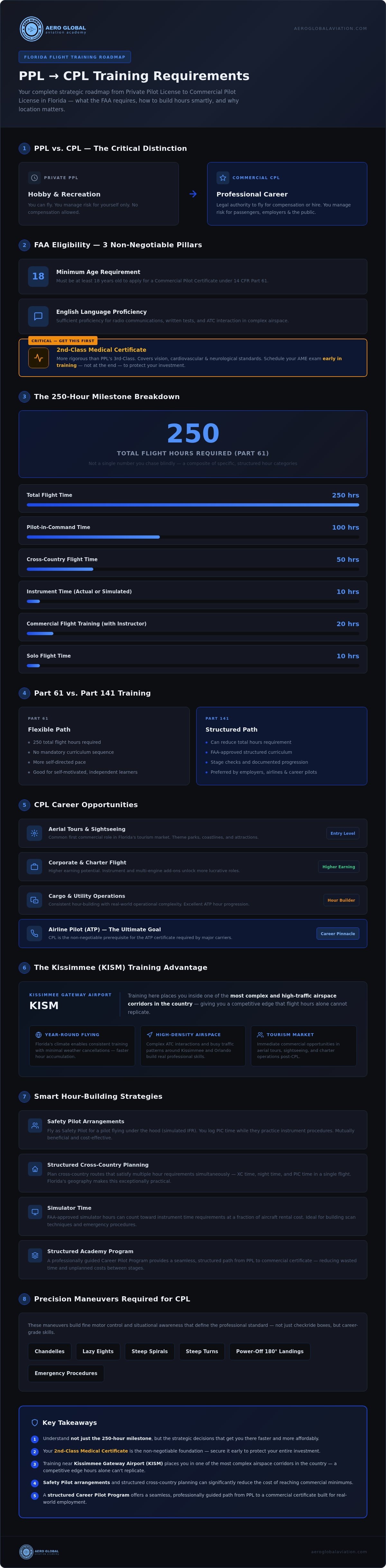
Under the 14 CFR Part 61 pilot certification regulations, a commercial applicant training under Part 61 must accumulate 250 total flight hours. That total isn't a single number you chase blindly. It breaks down into specific categories that each build a distinct layer of professional competency:
- 100 hours in powered aircraft as Pilot-in-Command (PIC)
- 50 hours in airplanes (if seeking an airplane CPL)
- 50 hours of cross-country flight time
- 10 hours of instrument training in actual or simulated IMC
- 10 hours in a complex, technically advanced, or turbine-powered aircraft
- 5 hours of night flight, including 10 takeoffs and 10 full-stop landings
Each category serves a purpose. Cross-country requirements build navigation discipline. Night flight hours develop spatial awareness and cockpit management under pressure. The instrument time connects directly to the Instrument Rating discussion below.
Part 61 vs. Part 141: Choosing Your Training Structure
This is where the PPL to CPL training requirements in Florida get strategically interesting. Part 61 offers flexibility, making it well-suited for pilots who already hold a solid hour base and want to fill specific gaps efficiently. Part 141, by contrast, follows an FAA-approved syllabus that allows qualified schools to reduce the total hour requirement to 190 hours for commercial certification. That's a meaningful difference in both time and cost.
Structured flight training under Part 141 also provides a documented, stage-check progression that many regional and charter employers view favorably during hiring. If your goal is a professional aviation career rather than recreational flying, that structure isn't a constraint. It's a competitive asset. Aero Global Academy's Career Pilot Program is built on exactly this logic, offering a defined pathway from your existing PPL to a commercially viable certificate without the guesswork of self-directed hour building.
The Instrument Rating Prerequisite
Technically, the FAA doesn't require a standalone Instrument Rating to earn your CPL. Practically, the aviation job market does. The vast majority of commercial employers, from charter operators to aerial survey companies, treat an Instrument Rating as a baseline hiring requirement. Flying in Florida's afternoon convective weather patterns makes this even more relevant locally.
The smart approach is integrating your IR training into the CPL journey rather than treating it as a separate, sequential step. The instrument hours you log toward your rating count toward your commercial minimums, and the precision mindset that instrument flight rules training develops directly sharpens the accuracy demanded on your CPL checkride. Two goals, one training arc. That's the kind of efficiency that keeps your timeline and budget on track.
If you're ready to map your specific hour gaps against a structured CPL syllabus, explore Aero Global Academy's Career Pilot Program to see how the path from your current certificate to commercial privileges can be planned with precision.
The Kissimmee Advantage: Why Central Florida Airspace Matters
Where you train matters as much as how you train. That's not a marketing claim; it's operational reality. The PPL to CPL training requirements in Florida can technically be completed anywhere in the country, but candidates who build their hours in Central Florida's complex airspace environment arrive at their checkride with a qualitative edge that's difficult to replicate in quieter training corridors.
Kissimmee Gateway Airport (KISM) sits at the center of that advantage. It's a Class D airport operating within the broader Orlando Terminal Control Area, which means you're working with active controllers from day one of your commercial training. You're not practicing radio calls. You're making real ones, in real time, with real traffic all around you.
The terrain diversity compounds this benefit. Within a single cross-country training day, you can transition from inland lakes and flat agricultural land to coastal approaches along the Gulf or Atlantic shorelines. That range of navigation environments builds the kind of adaptable situational awareness that employers actually test for during hiring.
Mastering Communication in Busy Airspace
Training adjacent to Orlando International (KMCO), one of the busiest airports in the southeastern United States, puts you in regular contact with Orlando Approach and Tower controllers managing complex traffic flows. Learning to communicate precisely under that kind of pressure, where a hesitant or unclear transmission has real consequences, builds a cockpit confidence that quieter training environments simply can't manufacture. Exposure to Class B and Class C airspace during your commercial training transforms what could be an intimidating environment into familiar professional territory.
Year-Round Training Efficiency
Central Florida's climate is a genuine strategic asset for candidates working through their commercial hour requirements. The region averages well over 230 flyable days per year, which means your training schedule stays consistent rather than stalling through weather-driven gaps that erode skills and stretch timelines.
That consistency matters for more than just momentum. Skill degradation is real, and pilots who train in weather-constrained environments often spend valuable flight hours rebuilding proficiency rather than advancing it. Here, you keep moving forward.
Florida's predictable afternoon convective patterns also teach you something equally valuable: weather decision-making. You'll learn to read developing storm systems, plan cross-country departures around them, and understand when the responsible call is to stay on the ground. That judgment is a core CPL competency, and Central Florida's climate delivers regular, low-stakes opportunities to develop it before it counts in a professional context.
For candidates working through the structured flight training environment that Aero Global Academy's Career Pilot Program provides, training at KISM means every flight hour is doing double duty: building your logbook and building your professional instincts simultaneously.
Strategic Hour Building: Reaching the 250-Hour Milestone
Knowing the FAA's 250-hour requirement is one thing. Getting there efficiently, without hemorrhaging your training budget or logging hollow hours that don't build real skill, is an entirely different discipline. This is where many PPL holders stall, and it's the gap that separates candidates who reach their commercial certificate on schedule from those who drift through unfocused hour accumulation for years.
The good news: the PPL to CPL training requirements in Florida create natural opportunities to build hours with purpose. Every flight should be doing two jobs simultaneously, advancing your logbook and sharpening a specific professional competency.
Cross-Country Planning for Commercial Pilots
Your commercial certificate requires a solo cross-country flight of at least 300 nautical miles, with full-stop landings at a minimum of three points. Don't treat this as a formality. Treat it as a dress rehearsal for professional operations. Plan routes that challenge your fuel management, require you to navigate multiple airspace transitions, and include at least one destination with an instrument approach procedure you can study in advance. Incorporating glass cockpit navigation tools like ForeFlight alongside your aircraft's avionics during this phase builds the digital fluency that modern employers expect from day one.
Safety Pilot arrangements are another underused strategy worth building into your plan early. When a fellow instrument-rated pilot acts as your Safety Pilot while you fly under the hood, both of you can log PIC time simultaneously under Part 61 rules. That's a legitimate, cost-sharing approach to building instrument hours and cross-country time that stretches your training budget without cutting corners on quality.
Complex and High-Performance Aircraft Endorsements
The FAA requires at least 10 hours of training in a complex aircraft, a technically advanced aircraft (TAA), or a turbine-powered airplane before your commercial checkride. This isn't just a checkbox. Learning to manage retractable landing gear and a controllable-pitch propeller introduces a genuine step-change in cockpit workload, and mastering it builds the systems-management habits that define professional-grade airmanship.
This is also where your preparation for commercial pilot maneuvers sharpens considerably. Chandelles and lazy eights demand precise energy management that translates directly to complex aircraft handling. Practicing them in a higher-performance platform deepens that connection.
Vary your environments deliberately throughout your hour-building phase. Night flights over Central Florida's lit coastline, cross-country trips that take you through mountainous terrain, and coastal approaches along the Gulf all develop the environmental adaptability that airline hiring panels specifically look for when reviewing logbooks.
One final discipline that candidates routinely underestimate: logbook precision. Every entry needs accurate category, class, and condition-of-flight coding. Airlines and regional carriers audit logbooks closely, and a single ambiguous entry can trigger questions that slow your hiring process. Build clean habits now, before it costs you.
If you want a structured framework that maps your existing hours against commercial minimums and builds a clear plan forward, connect with Aero Global Academy's Career Pilot Program to start planning your hour-building strategy today.
Aero Global Academy: Your Partner from PPL to Elite Careers
Mastering the PPL to CPL training requirements in Florida is a significant achievement, but it's only the beginning of your story. At Aero Global Academy, we don't view these certifications as isolated hurdles. We see them as the structural components of a lifelong career. Our role is to act as your practical mentor, providing the expert guidance and regional advantages you need to move from a private pilot to a professional commander with absolute confidence.
Every student's journey is unique, which is why we offer defined pathways tailored to your specific destination. For those just starting, the Wings Foundation provides the essential PPL base. If your goal is the commercial flight deck, our Career Pilot Program serves as the logical next step, bridging the gap between recreational flying and professional standards. For the most ambitious candidates, the Airline Pilot Elite track carries you all the way through advanced instructor certifications, ensuring you have the highest credentials in the 2026 market.
Integrated Training for Faster Results
Efficiency in training comes from structure, not shortcuts. Our Career Pilot Program aligns every flight hour with current airline hiring standards. We prioritize a steady, inviting rhythm of progression that keeps you moving toward your checkride without the "training rust" that comes from inconsistent scheduling. By training with a modern, well-maintained fleet at our Kissimmee facility, you're learning on equipment that mirrors what you'll encounter in the professional world.
Our instructors bring real-world airline experience to every briefing. They don't just teach you how to pass a test; they show you how to manage a cockpit under the pressure of professional operations. This mentorship is what transforms a student into a peer, making the complex world of commercial aviation feel within reach.
Beyond the License: Career Support
A license gets you the interview, but your preparation gets you the job. We leverage our deep roots in the Florida aviation community to provide networking opportunities that extend far beyond the hangar. From resume building that highlights your specific training in busy Orlando airspace to interview prep designed for regional carrier protocols, we stay invested in your success long after your commercial checkride is complete.
Your professional future is a tangible destination, and the path starts with a single, decisive step. We invite you to experience our culture of excellence firsthand. Whether you're ready to start your journey or still exploring how to get your private pilot license in Florida, you can book a discovery flight or tour our Kissimmee facility today. Let's turn your passion for flight into a professional reality.
Your Commercial Certificate Is Closer Than You Think
The PPL to CPL training requirements in Florida aren't a maze. They're a structured, achievable roadmap that rewards candidates who train strategically rather than simply logging hours. Your Second-Class Medical, your 250-hour milestone, your instrument proficiency, and your complex aircraft endorsement all build on each other when approached with a clear plan.
What separates pilots who reach their commercial certificate on schedule from those who drift is the quality of their training environment and the guidance behind it. Kissimmee-based training puts you inside genuinely demanding airspace from day one. FAA-approved structured career tracks keep your progression measurable and employer-ready. And mentorship from airline veterans means you're not just passing checkrides; you're developing the professional instincts that hiring panels actually look for.
The flight deck you're aiming for is a real destination, and the path starts with a single decisive step. Start your professional journey with Aero Global Academy and let's build your career together. You've already earned your wings. Now it's time to put them to work.
Frequently Asked Questions About PPL to CPL Training Requirements in Florida
How many hours do I need to go from PPL to CPL in Florida?
Under Part 61, you need 250 total flight hours to qualify for your Commercial Pilot License. That total includes specific sub-requirements: 100 hours as Pilot-in-Command, 50 hours of cross-country time, 10 hours of instrument training, 10 hours in a complex or technically advanced aircraft, and 5 hours of night flight. Part 141 schools can reduce the total to 190 hours through an FAA-approved structured syllabus, which represents a meaningful saving in both time and cost.
Can I work as a pilot immediately after getting my Commercial License?
Yes, your CPL legally authorizes you to fly for compensation or hire the moment it's issued. Practical entry points include aerial tours, banner towing, cargo operations, and charter flights. Most employers in these roles also expect an Instrument Rating alongside your CPL, so building that credential into your training rather than pursuing it separately puts you in a stronger position to start earning sooner.
What is the difference between Part 61 and Part 141 CPL requirements?
Part 61 is flexible and self-directed, making it a reasonable fit for pilots who already hold a solid hour base and want to fill specific gaps on their own schedule. Part 141 follows an FAA-approved syllabus with structured stage checks, which allows qualified schools to reduce the commercial hour minimum to 190 hours. For pilots pursuing a professional career, Part 141's documented progression is also viewed favorably by many regional and charter employers during the hiring process.
Do I need an Instrument Rating before starting CPL training?
The FAA doesn't require a standalone Instrument Rating as a prerequisite for your CPL. The practical reality, though, is that most commercial employers treat it as a baseline hiring requirement. The smarter approach is integrating your IR training into your CPL journey so the instrument hours you log count toward both credentials simultaneously. This keeps your timeline efficient and ensures you arrive at your first commercial job fully competitive.
How long does it typically take to complete a PPL to CPL program?
Timeline varies depending on your existing hour base, training structure, and schedule consistency. Pilots training under a structured Part 141 program in a favorable flying environment can complete their CPL in roughly 12 to 18 months after their PPL, assuming regular flying frequency. Central Florida's year-round flyable weather is a genuine advantage here; training gaps driven by weather are far less common than in many other regions, which keeps your progression steady rather than stalled.
Are there financing options available for commercial pilot training in Florida?
Financing availability varies by school and individual circumstances, so it's worth asking each program directly about what options they support. Common funding paths candidates explore include aviation-specific loans, veteran education benefits for those who qualify, and employer-sponsored training programs offered by some regional carriers. We recommend contacting Aero Global Academy directly to discuss what financial planning resources may be available for their Career Pilot Program.
What medical certificate do I need for a Commercial Pilot License?
A Second-Class Medical Certificate is required to exercise commercial pilot privileges. The standards are more rigorous than the Third-Class certificate that covers private pilot flying, with closer scrutiny on vision, cardiovascular health, and neurological history. Schedule your exam with an FAA-designated Aviation Medical Examiner early in your CPL training process. Identifying any potential issues before you've invested heavily in training is one of the most important risk-management decisions you can make.
Why is Central Florida considered the best place for flight hour building?
The PPL to CPL training requirements in Florida can technically be completed anywhere, but Central Florida's combination of factors is genuinely difficult to match. The region averages well over 230 flyable days per year, keeping your training schedule consistent. Kissimmee Gateway Airport sits within the broader Orlando airspace corridor, giving you regular exposure to Class B and Class C environments that build real controller communication skills. Add diverse terrain for cross-country variety and you have a training environment that builds logbook hours and professional instincts at the same time.


