
What if the biggest obstacle between you and a commercial cockpit isn't your talent, but the specific runway you choose to start from? You likely feel the weight of long, drawn-out training timelines and the confusing maze of FAA requirements that seem designed to slow you down. It's frustrating to watch your career goals stall while costs climb, but finding the fastest way to become a pilot in Orlando doesn't have to be a mystery. We understand that you're ready to trade the classroom for the clouds, and you need a roadmap that respects your time and your ambition.
In this 2026 guide, you'll discover the strategic steps and local advantages that allow dedicated students to transition from zero experience to a professional level in record time. We'll show you why training at Kissimmee Gateway Airport (KISM) offers a high-speed alternative to more congested regional hubs. You will learn how structured paths like the Wings Foundation and our Career Pilot Program maximize your flyable minutes by leveraging Florida's unique climate and streamlined curriculum. This article provides a clear, actionable plan to help you secure your commercial license and launch your aviation career with confidence and speed.
Key Takeaways
- Learn why year-round flyable weather and the strategic location of Kissimmee Gateway Airport (KISM) represent the fastest way to become a pilot in Orlando by eliminating seasonal training delays.
- Discover how maintaining a high-frequency flight schedule of four to five days a week prevents skill regression and significantly compresses your overall certification timeline.
- Understand the essential first steps, including securing your FAA Medical Certificate and completing the Wings Foundation course, to ensure your training remains uninterrupted.
- Explore specialized professional pathways like the Career Pilot Program and Airline Pilot Elite track that are engineered to move you from zero experience to a commercial cockpit efficiently.
- Find out how to use a Discovery Flight as a strategic evaluation tool to ensure your training environment and instructors align with your professional speed goals.
Maximising Your Training Window: Why Orlando is the Speed Capital
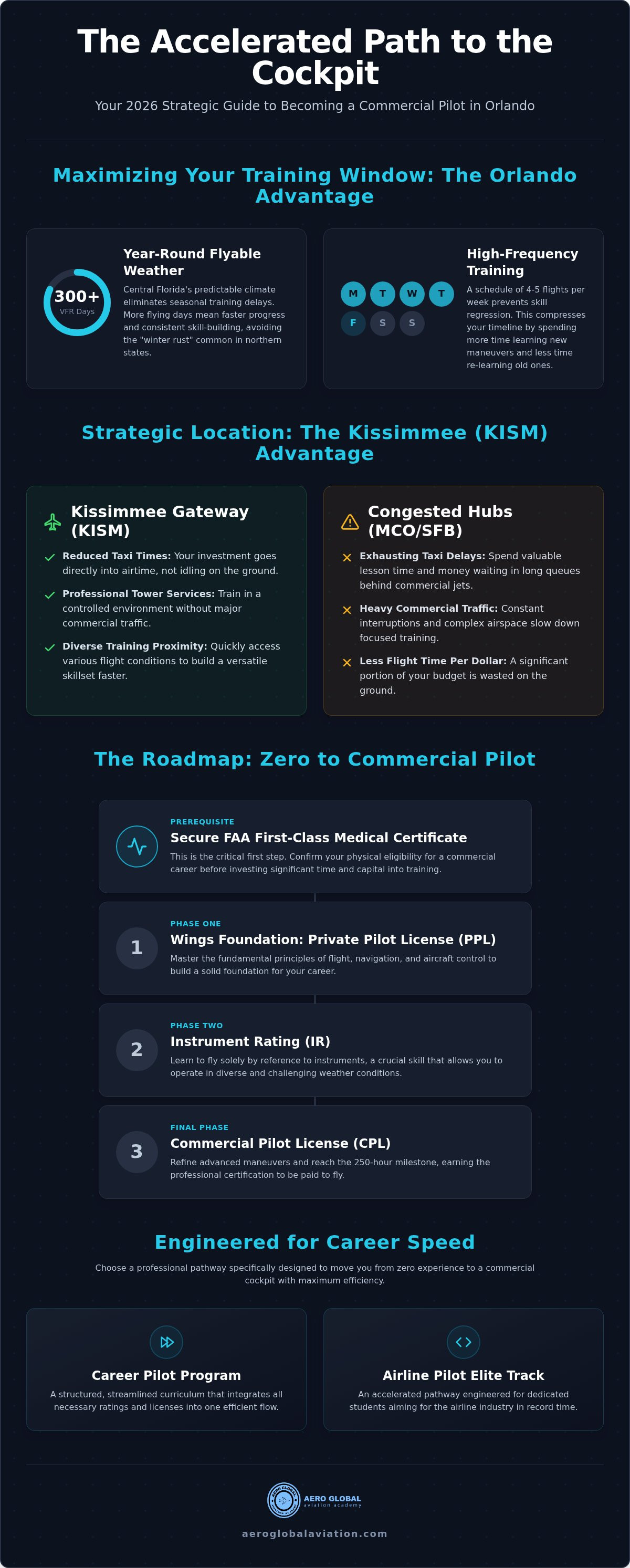
Choosing the right location is the first and most critical decision you'll make on your journey to the flight deck. While many regions offer flight schools, Central Florida stands as the most robust training hub in the United States as we move through 2026. The fastest way to become a pilot in Orlando isn't just about finding a school; it's about finding an environment that eliminates the friction of downtime. In northern states, student pilots often lose weeks or even months to "winter rust," where snow and low clouds ground aircraft and stall progress. Here, you maintain a consistent rhythm that is essential for building muscle memory and professional confidence.
Consistency drives speed more than any other factor in aviation. When you fly four to five times a week, you spend less time reviewing previous lessons and more time mastering new maneuvers. This high-frequency training ensures that you meet the standards for FAA pilot certification without the setbacks caused by long gaps in your schedule. Orlando's flat terrain and high density of dedicated practice areas also mean you spend less time "commuting" through the air to reach your training zones, allowing every minute of your engine time to count toward your license.
Year-Round Flyable Days in Central Florida
The primary advantage for student pilots in Orlando is the abundance of VFR (Visual Flight Rules) days. VFR weather describes atmospheric conditions with clear skies and high visibility that allow you to navigate visually, a state that persists for over 300 days a year in Central Florida. This predictable climate allows our instructors to build reliable schedules that don't shift with the seasons. You'll move through your phase checks with a level of momentum that is simply impossible in more volatile climates, turning what could be a multi-year process into a streamlined professional transition.
Kissimmee Gateway Airport (KISM) vs. Congested Airspace
Efficiency in training often comes down to where you take off. While major hubs like Orlando International (MCO) or Sanford (SFB) are busy with massive commercial jets, Kissimmee Gateway Airport (KISM) offers a superior alternative for those seeking the fastest way to become a pilot in Orlando. At KISM, you benefit from professional tower services and a controlled environment without the exhausting taxi delays common at larger airports.
Every minute you spend idling on the tarmac at a congested airport is a minute you're paying for without gaining experience. At KISM, reduced taxi times ensure your investment goes directly into the air. Furthermore, the airport's proximity to diverse training environments, including coastal routes and inland corridors, accelerates your exposure to different flying conditions. This variety builds a more versatile skill set in a fraction of the time, preparing you for the high-stakes world of commercial aviation with unmatched efficiency.
The Fast-Track Roadmap: From Zero to Commercial Pilot
Securing your future in the skies requires more than just passion; it demands a disciplined sequence of milestones. While many schools offer a vague timeline, identifying the fastest way to become a pilot in Orlando requires a roadmap that prioritizes efficiency at every turn. You don't want to spend years waiting for your career to take off. By following a structured professional path, you can compress the journey from a beginner to a commercial aviator while ensuring you meet all requirements governed by official FAA pilot certification regulations.
Your journey begins before you ever touch the flight controls. Secure an FAA First-Class Medical Certificate as your very first step. This ensures your physical eligibility for a commercial career before you invest significant time or capital. Once cleared, you'll move through these specific phases:
- The Wings Foundation: Master the fundamentals and earn your Private Pilot License (PPL).
- Instrument Rating (IR): Learn to fly by reference to instruments, allowing you to operate in diverse weather conditions.
- Commercial Pilot License (CPL): Reach the 250-hour milestone while refining advanced maneuvers.
- Multi-Engine Rating: Add the technical skills required to operate complex, multi-engine aircraft used by major airlines.
The Wings Foundation: Fast-Tracking Your PPL
The first major hurdle is the Private Pilot License. Our Wings Foundation course is engineered to focus on the essential skills required to solo as early as safely possible. By stripping away "syllabus creep" and focusing on the core competencies of flight, we keep your training on a strict schedule. Earning a private pilot license in Florida serves as the bedrock of your career, and doing so in an accelerated environment sets the pace for everything that follows.
Instrument Rating and Commercial Certification
Speed in training often stalls when pilots are limited by weather. By pursuing an Instrument Rating immediately after your PPL, you transition from VFR to IFR (Instrument Flight Rules). This eliminates many weather-related cancellations and allows you to build time consistently. You'll utilize Florida's vast network of regional airports to execute cross-country requirements efficiently. This phase leads directly into commercial pilot training, where you refine the professional maneuvers and precision required for a commercial certificate. If you're ready to see how this roadmap fits your personal goals, you can explore our specific course timelines to find your starting point.
The final piece of the puzzle is the Multi-Engine rating. This qualification is what separates general aviators from elite airline candidates. By integrating this into your final training stages, you ensure that you're not just a pilot, but a highly competitive professional ready for the 2026 hiring market.
Strategic Efficiency: How to Cut Months Off Your Training
Speed in aviation training isn't about rushing through safety protocols or skipping essential maneuvers. Instead, it involves maximizing your "flyable minutes" and ensuring that every hour spent in the cockpit builds on the last without any loss of skill. Finding the fastest way to become a pilot in Orlando requires a shift in mindset where you treat your education as a high-priority professional commitment rather than a casual hobby. By adopting specific strategic efficiencies, you can shave months off your timeline and reach your career goals much sooner than the industry average.
One of the most effective ways to accelerate your progress is by aligning your journey with a structured career pilot program. These programs are designed to eliminate the gaps between ratings, ensuring that as soon as you pass one checkride, you're already scheduled for the next phase of training. This seamless transition is vital for maintaining momentum and ensuring you stay on track to meet the commercial pilot training requirements set by the FAA.
- Immersive Frequency: Fly at least four days per week to lock in muscle memory and reduce the need for review sessions.
- Simulation Mastery: Use high-quality flight simulators to practice emergency procedures and cockpit flows before you ever start the engine.
- Ground Theory Prep: Study and pass your written exams before starting your primary flight blocks to keep your focus entirely on the aircraft.
The Power of Immersion and Frequency
The difference between a "weekend warrior" and an immersive student is staggering. Pilots who only fly once or twice a week often find themselves spending the first half of every lesson relearning what they forgot since their last flight. This leads to a cycle of stagnation that can make training take two to three times longer. By committing to a four-day-per-week schedule, you can reduce your total PPL training time by as much as 30%. This frequency creates a psychological benefit where flight operations become second nature, allowing you to focus on advanced decision-making rather than basic aircraft control.
Pre-emptive Ground School and Testing
Ground school is often the hidden bottleneck that grounds promising students. To maintain your speed, you should aim to pass your FAA written exams as early as possible. Utilizing digital tools and academy resources to master regulations at home allows you to arrive at the airport ready to fly, not study. We focus on achieving "Checkride Readiness" through consistent mock evaluations that mirror the intensity of the actual exam. This proactive approach ensures that when your flight hours are met, your paperwork and knowledge are already in place, allowing you to schedule your checkride without delay.
Choosing the Right Professional Program for Career Speed
Identifying the fastest way to become a pilot in Orlando isn't about looking at the size of a flight school's fleet; it's about evaluating the structure of their professional programs. While some schools boast hundreds of aircraft, those numbers don't help if you're stuck in administrative limbo or waiting for a flight slot. You need a partner that consolidates scheduling and billing into a single, cohesive experience. This keeps you focused on your training milestones rather than paperwork, ensuring that your momentum never stalls between ratings.
Professional tracks are designed to remove the guesswork from your education. By choosing a program that maps out every step from your first flight to your commercial checkride, you eliminate the delays that independent students often face. These programs provide a clear, logical progression that respects your time and your investment, making the transition from a beginner to a professional aviator feel both structured and attainable.
Career Pilot Program: The Direct Route
Our Career Pilot Program is specifically engineered for the PPL-to-CPL transition, moving you through your ratings without the pauses that often plague independent students. You'll train in professional-grade aircraft equipped with modern avionics that mirror the cockpits of regional jets. This high-level training environment ensures that your path to major airlines is smooth and that you're prepared for the technical demands of a commercial career from day one. By focusing on consistency and professional standards, this route serves as a high-speed corridor to your commercial certificate.
Airline Pilot Elite: Preparing for the Flight Deck
For those with their sights set on the highest levels of aviation, the Airline Pilot Elite track is the ultimate launchpad. This comprehensive program includes instructor ratings such as CFI and CFII, which are the fastest ways to build the 1,500 flight hours required for airline eligibility. Becoming an instructor allows you to gain experience and get paid while you work toward your ultimate destination. You'll also master advanced multi-engine training, which is a critical differentiator that helps you stand out to recruiters in a competitive 2026 market.
Being part of an elite academy in the Kissimmee hub means you have access to mentors who are deeply invested in your individual success. We act as your practical guide, helping you navigate the complexities of the industry with confidence. If you're ready to commit to a professional timeline and start your journey, view our accelerated program details to see which track matches your speed goals.
Taking the First Step: Your Accelerated Launchpad
Every professional aviation career begins with a single moment of decision. However, the fastest way to become a pilot in Orlando requires you to move beyond simple curiosity and into a phase of active evaluation. You aren't just looking for a school that can teach you to fly; you're looking for a high-performance partner that can match your pace and professional urgency. By treating your initial visit as a diagnostic tool, you ensure that your investment is placed in an environment designed for rapid, consistent progress rather than one that will leave you waiting on a crowded flight line.
To keep your momentum high, you must address the logistical foundations of your training before you ever clear for takeoff. This means aligning your finances, your schedule, and even your living situation to support a full-time commitment. When these elements are in place, you remove the external stressors that often lead to training pauses, allowing you to focus entirely on mastering the aircraft and advancing through your ratings.
The Discovery Flight: Your Speed Assessment
Most schools position the Discovery Flight as a scenic joyride, but for the career-minded student, it's a critical assessment of the academy’s operational efficiency. During this flight, pay close attention to the pre-flight briefing. Is it structured and professional, or does it feel chaotic and rushed? A well-organized briefing is a direct reflection of how your future phase checks and ground school sessions will be handled.
You should also take this time to verify aircraft availability. Ask specifically if there are enough planes in the fleet to support a four-day-a-week training goal without constant cancellations. Finally, use this opportunity to meet the instructors. You want to find a mentor who understands the 2026 hiring landscape and shares your sense of urgency. A mentor who is focused on your individual success will be the most valuable asset in your transition from a student to a commercial pilot.
Financing and Housing for Full-Time Students
Financial interruptions are the most common reason students get grounded. Exploring flight training financing options early in the process allows you to secure the capital needed for an uninterrupted journey from your Private Pilot License to your Commercial Multi-Engine rating. Having a clear payment plan in place ensures that your training rhythm remains steady, which is the primary driver of speed in any accelerated program.
For full-time students, geography is a strategic asset. We highly recommend exploring local housing options in the Kissimmee area to minimize your daily commute. Living near Kissimmee Gateway Airport (KISM) makes it much easier to secure the coveted early morning flight slots, which often provide the most stable weather conditions for primary training. When you eliminate a long drive, you gain more time for rest and ground study, both of which are essential for maintaining the high-intensity pace of a professional track. If you're ready to build a personalized timeline based on your specific 2026 career goals, we invite you to schedule a consultation at our academy and take the first definitive step toward the flight deck.
Your Professional Flight Path Starts at Kissimmee Gateway
Your journey from a beginner to a commercial aviator is a high-stakes transition that requires more than just flight hours; it requires a strategic environment. You've seen how the year-round flyable weather and the operational efficiency of Kissimmee Gateway Airport (KISM) eliminate the delays found in other regions. By following our comprehensive Career Pilot Program roadmap, you ensure that every lesson builds directly toward your goal of a commercial cockpit. This structured approach, combined with the guidance of our professional mentors, transforms a complex process into an attainable professional reality.
Choosing a training partner that respects your sense of urgency is the fastest way to become a pilot in Orlando. We are dedicated to providing the personalized attention and technical expertise you need to stand out in the 2026 hiring market. Don't let your ambitions wait on the ground while others take flight. Our academy is designed to keep you moving forward with confidence and precision.
Book your Discovery Flight at Aero Global Aviation Academy today and experience the difference of a program built for speed and excellence. We're ready to help you reach your professional destination and launch your career in the skies.
Frequently Asked Questions
How long does it take to become a pilot in Orlando if I train full-time?
Full-time training in Central Florida typically allows a dedicated student to earn a Private Pilot License in approximately three months. For those pursuing a professional career, reaching a Commercial Pilot License usually takes between 12 and 14 months. This timeline assumes a consistent schedule of flying four to five days per week to maintain momentum and skill retention.
Is it faster to train under Part 61 or Part 141 in Florida?
Part 141 programs are often faster for career-oriented students because they follow a highly structured, FAA-approved syllabus that reduces wasted flight time. While Part 61 offers more flexibility for casual learners, the rigid framework of a Part 141 school is often the fastest way to become a pilot in Orlando. This structure ensures every hour in the air moves you directly toward your next professional rating.
What is the fastest way to build the 1,500 hours needed for airlines?
Becoming a Certified Flight Instructor (CFI) is the most efficient method for building the 1,500 flight hours required by major airlines. Once you earn your CFI rating through a program like Airline Pilot Elite, you can work as an instructor. This allows you to gain valuable experience and earn a living while building hours every day alongside your students.
Can I start flight training in Orlando without any prior experience?
Yes, you can start with zero prior experience. Most professional academies are designed to take you from your very first flight through all the necessary certifications. Starting with a foundational course like the Wings Foundation allows you to master basic maneuvers before transitioning into the more complex requirements of instrument and commercial flying.
How much does it cost to get a commercial pilot license in 2026?
Current industry data for 2026 suggests that a complete professional pilot training package from zero experience to a commercial multi-engine rating typically ranges between $85,000 and $120,000. These figures reflect the rising costs of fuel and instructor rates across the United States. You should always verify specific enrollment costs and any available scholarship opportunities during your initial consultation.
Why is Kissimmee Gateway Airport better for fast training than MCO?
Kissimmee Gateway Airport (KISM) is superior for training because it lacks the heavy commercial airline traffic that causes long taxi delays at Orlando International (MCO). At KISM, you spend significantly less time waiting on the tarmac and more time practicing maneuvers in the air. This efficiency ensures that your training budget is spent on actual flight experience rather than idling engines.
Do I need a college degree to become an airline pilot quickly?
You do not need a college degree to begin flight training or to secure a position at many regional airlines. Focusing exclusively on your flight ratings is the fastest way to become a pilot in Orlando and enter the professional workforce. While some major carriers may prefer a degree later in your career, many pilots choose to complete their education online while already working as a first officer.
What is the best month to start flight school in Orlando for maximum flyable days?
While Orlando provides over 300 flyable days annually, starting in the autumn or winter months, specifically between October and February, is ideal. These months offer the most stable visual flight conditions with fewer afternoon thunderstorms than the summer season. Establishing your training rhythm during this period helps you clear your initial solo and private pilot milestones without weather-related interruptions.


