What if the most direct path to a $226,600 airline salary isn't just about logging hours, but about where and how you start? It's natural to feel overwhelmed by the rising costs of flight school or the sheer complexity of FAA ratings. You want a career in the sky, but the fear of choosing a school that lacks real industry connections can feel like a heavy anchor. Choosing the right professional pilot training Orlando offers is the first step toward turning that uncertainty into a structured career path.
We're here to show you how to transition from a student pilot to a professional aviator using Florida's unique geographic advantages and proven training frameworks. You'll discover how the "Kissimmee Advantage" provides the year-round flying weather you need to stay on schedule and maximize your time in the cockpit. This guide provides a clear 2026 roadmap, outlining everything from your first solo to advanced certifications like the Airline Pilot Elite program. We'll preview the step-by-step timeline and mentorship you need to fly with confidence and land a position in a high-demand industry.
Key Takeaways
- Understand why Central Florida remains the premier global hub for aviators and how the local climate accelerates your path to certification.
- Explore structured tracks like the Career Pilot Program to transform your initial interest into a professional commercial license.
- Learn how the "Kissimmee Advantage" at KISM reduces wait times on the tarmac, ensuring every minute of your training is spent in the air.
- Follow a clear 5-step checklist for starting professional pilot training Orlando and discover how to navigate the financial commitments of flight school.
- Gain insights into the mentorship-driven approach that prepares you for the high-stakes standards of modern airline employment.
Why Choose Professional Pilot Training in Orlando in 2026?
Professional pilot training isn't just about learning to steer an airplane; it's a rigorous, goal-oriented journey toward meeting FAA pilot certification standards. Choosing professional pilot training Orlando means you're stepping into a structured environment designed to take you from your first flight to a commercial flight deck. We don't just teach you how to fly; we prepare you for a lifelong career. It's a path that requires dedication, but the rewards of a life in the sky are well worth the effort.
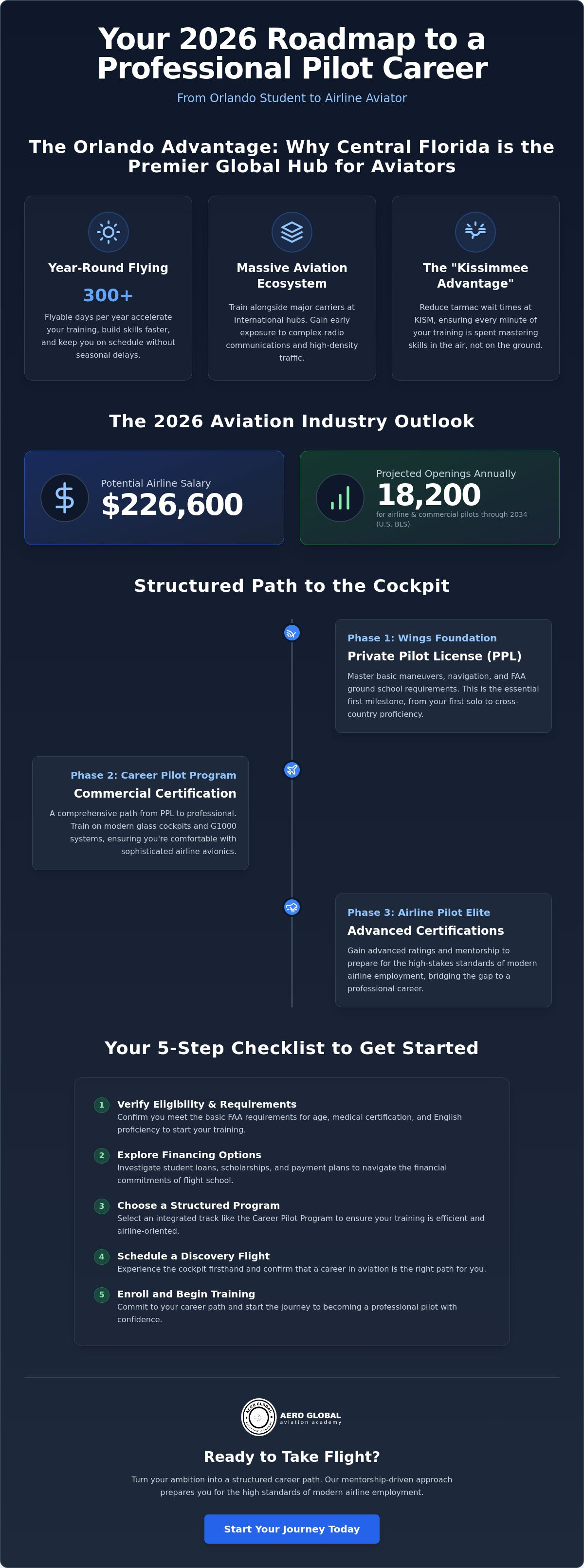
Florida's geography is your greatest asset. With over 300 days of flyable weather each year, you won't find your progress stalled by weeks of gray skies or ice. This consistency allows you to build hours faster, keeping your skills sharp and your graduation date within reach. It's all about momentum. When you can fly almost every day, your muscle memory develops faster, and you reach your milestones with greater efficiency. You'll spend less time waiting for the clouds to clear and more time mastering the art of flight.
Training here puts you in the middle of a massive aviation ecosystem. You'll share the skies with major carriers at international hubs, giving you early exposure to complex radio communications and high-density traffic. It's the kind of experience that makes the transition to a regional airline feel like a natural next step. You'll learn to navigate busy airspace while maintaining the professional standards expected of a commercial aviator. This real-world context is something you simply can't replicate in quieter, more isolated regions.
The 2026 Aviation Industry Outlook
The demand for skilled aviators is higher than ever. The U.S. Bureau of Labor Statistics projects an average of 18,200 openings for airline and commercial pilots every year through 2034. Training in a high-density environment like Orlando prepares you for this reality. Our programs, such as the Career Pilot Program, are built to bridge the gap between classroom theory and the professional standards required by modern airlines. You'll enter the job market not just with a license, but with the confidence of someone who has trained in the world's premier flight hub.
Orlando vs. Other Training Hubs
While other regions struggle with seasonal delays, Orlando offers year-round Visual Flight Rules (VFR) conditions. You'll have access to diverse airspace, ranging from quiet rural practice areas to busy controlled zones near international airports. This variety builds a versatile pilot. Beyond the cockpit, the networking benefits here are unmatched. You're surrounded by a community of instructors, mechanics, and recruiters who are all part of the Central Florida aviation legacy. It's an environment where your success is supported by everyone around you, making your professional goals feel within reach.
Structured Paths to the Cockpit: Our Professional Programs
Many students make the mistake of treating flight training like a series of disconnected hobbies. To reach the airlines, you need a cohesive Professional Pilot Track. This integrated approach ensures every hour in the cockpit builds toward your end goal. It's why professional pilot training Orlando is so effective when delivered through a syllabus-driven curriculum. We use modern technology, such as glass cockpits and G1000 systems, from your very first flight. This ensures you're comfortable with the sophisticated avionics you'll eventually find in a commercial jet. By treating every lesson as a step toward a professional career, we help you develop the discipline and precision that airline recruiters look for.
Wings Foundation: Building the Private Pilot Base
Your journey begins with the Wings Foundation. This course focuses entirely on the Private Pilot License (PPL), which is the essential first milestone for any aviator. You'll master basic maneuvers, navigation, and FAA ground school requirements. It's the stage where you transition from your first solo flight to full cross-country proficiency. By following the official FAA requirements, we ensure your foundation is rock solid before you move to more complex ratings. This isn't just about passing a test; it's about becoming a safe, competent pilot from the ground up.
Career Pilot Program: From PPL to Commercial Certification
The Career Pilot Program is designed for those who want to move beyond the basics and into a professional role. This is the comprehensive path from a private pilot license florida to a full Commercial Pilot License (CPL). You'll focus on building the 250 flight hours required for a CPL through structured time-building. This phase is critical for your development. Our professional pilot training Orlando programs ensure you're mastering advanced maneuvers and commercial operational standards that prepare you for the daily responsibilities of a professional aviator.
Airline Pilot Elite: Advanced Instructor Tracks
The Airline Pilot Elite program offers the highest credentials, including Certified Flight Instructor (CFI) ratings. Instructor certifications are often considered the gold standard for airline applications because they prove you truly understand the mechanics of flight. Teaching others is the most effective way to master your own skills and demonstrate you're ready for the elite tiers of professional aviation. If you're ready to start your journey, you can explore our training programs to find the best fit for your goals. We're here to guide you through every rating until you reach the cockpit.
The Kissimmee Advantage: Efficient Training Environments
Every minute your engine is running on the ground is a minute you aren't learning to fly. While larger hubs like Orlando International (MCO) are impressive, they often involve long taxi times and frequent delays due to heavy airline traffic. This is why we've chosen Kissimmee Gateway Airport (KISM) as our strategic training base. KISM offers what we call tarmac efficiency. You'll spend less time idling on the taxiway and more time in the air mastering your maneuvers. This streamlined environment is essential for anyone pursuing professional pilot training Orlando, as it ensures your training hours are spent where they matter most: in the cockpit and under the guidance of an instructor.
Training at KISM provides a sophisticated learning environment that balances challenge with accessibility. You'll operate within Class D controlled airspace, which builds your confidence in communicating with Air Traffic Control (ATC) from day one. However, because KISM is less congested than major international hubs, you have immediate access to nearby uncontrolled airspace for practice. This mix is vital for developing a well-rounded skill set. You'll also learn to navigate using local landmarks like the Central Florida lakes and theme park structures, which provides excellent real-world VFR (Visual Flight Rules) navigation experience that prepares you for any terrain.
Optimizing Your Flight Hours
Lower airport congestion directly translates into more landings per hour. When you aren't waiting for a line of commercial jets to depart, you can perform multiple touch-and-goes in a single session. This increased frequency accelerates your skill acquisition and can significantly lower your total training cost by reducing the number of flight hours needed to reach proficiency. It's one of many reasons why Kissimmee is the 'hidden gem' for commercial pilot training. You get the professional experience of a towered airport without the frustrating delays of a massive hub.
Living and Training in Central Florida
Choosing professional pilot training Orlando means you're moving to a region built for hospitality and aviation. Students relocating to the area will find plenty of local amenities, from affordable housing to world-class dining and recreation. There's a supportive, tight-knit community atmosphere at Kissimmee Gateway where pilots of all levels share insights and encouragement. Best of all, the Aero Global Aviation Academy facilities are located right in the heart of this activity, making it easy to transition from ground school to the flight line without a long commute. You're not just joining a school; you're becoming part of a thriving aviation family.
Navigating the Challenges: Financing and Requirements
Entering professional pilot training Orlando is a significant life decision that requires both mental and financial preparation. We understand that the time commitment and the cost of flight school are often the biggest hurdles for aspiring aviators. However, when you view this journey as a structured path toward a high-earning career, the obstacles become manageable. The first step is always clarity. Before you ever step into a cockpit, you need a solid plan to ensure your training remains consistent and uninterrupted. Consistency is the secret to finishing on time and on budget.
To help you get started, we've developed a clear 5-step checklist for beginning your professional journey:
- Schedule an FAA First Class Medical exam: This ensures you meet the physical requirements for a commercial career before you invest in training.
- Apply for a Student Pilot Certificate: You'll do this through the FAA's IACRA website to officially begin your record of training.
- Secure your funding: Whether through savings or financing, having your budget in place prevents training delays.
- Select your training structure: Decide between the flexibility of Part 61 or the rigid, airline-style curriculum of Part 141.
- Commit to a schedule: Aim for at least three to four lessons per week to maintain your proficiency and momentum.
Understanding the difference between training structures is vital. Part 61 schools offer a flexible, personalized pace that works well for students with busy schedules. Part 141 schools follow a strictly FAA-approved syllabus, which can sometimes lead to lower flight hour requirements for certain certificates. Regardless of the path you choose, starting with an FAA First Class Medical is non-negotiable for anyone dreaming of an airline cockpit. It's better to verify your eligibility early so you can fly with peace of mind.
Evaluating Flight Training Costs and ROI
It's helpful to view flight training as a career investment rather than a simple expense. While the initial costs are significant, the long-term salary potential for commercial pilots is substantial. When you are comparing the best flight schools in florida, look beyond the hourly rental rates. Consider the quality of the aircraft, the experience of the mentors, and the school's track record for student success. A slightly higher hourly rate at a more efficient school can actually save you money by helping you reach proficiency in fewer total hours.
Financing Your Aviation Dreams
You have several options when it comes to paying for your professional pilot training Orlando. Many students prefer a pay-as-you-go model to avoid debt, while others utilize block-rate financing to secure lower rates for paying in advance. There are also aviation-specific scholarships and student loan programs designed specifically for career-track pilots. Managing your costs during the hour-building phase is easier when you have a dedicated mentor helping you track your progress. If you're ready to take the first step toward your new career, you can apply for flight training today and start your journey toward the flight deck.
Why Aero Global Aviation Academy is Your Career Partner
At Aero Global Aviation Academy, we don't view you as just another student number in a logbook. We see our relationship as a professional partnership. Choosing the right school for professional pilot training Orlando is about finding a team that will stand by you from your first takeoff to your final airline interview. We're committed to your success because we know that our reputation is built on the quality of the pilots we produce. Our "Practical Mentor" philosophy ensures you're learning from instructors who are deeply invested in your specific career goals and personal development.
Our instructors bring a wealth of experience to the flight line, focusing on more than just the technical ability to fly. We emphasize the professional standards, leadership, and decision making skills that modern airlines demand. The career pilot program is specifically designed to polish these traits. We help you prepare for the high stakes environment of airline interviews by treating every lesson as a step toward your professional future. You'll enter the job market with the confidence and poise of a seasoned aviator.
Our Professional Training Fleet
Reliability begins with the equipment you use every day. We provide a fleet of modern, well-maintained aircraft that mirror the technology you'll encounter in the commercial world. Training on these sophisticated platforms makes the eventual transition to advanced flight training feel like a natural progression. Safety is our non-negotiable foundation. Our maintenance protocols exceed standard FAA requirements because your safety is our top priority. When you fly with us, you're training in equipment that is as ready for the mission as you are.
Join the Aero Global Family
We believe that smaller class sizes lead to better pilots. By limiting our enrollment, we ensure you receive the personalized instructor attention you deserve. You'll never feel lost in a crowd or stuck on a waiting list. This intimate environment fosters a supportive community where students and mentors share insights and celebrate milestones together. Our graduates are currently flying for major and regional airlines, proving that our mentorship-driven approach to professional pilot training Orlando delivers real results. Their success is a roadmap for your own.
The journey to a rewarding career in aviation is closer than you think. We have the tools, the location, and the expertise to help you reach the flight deck. Don't let your dreams stay on the ground. You can Schedule a Discovery Flight at our Kissimmee Training Center today to meet our team and experience the Aero Global difference firsthand. Your future in the sky starts with a single step, and we're ready to take it with you.
Take Command of Your Aviation Future
The path to the flight deck is clear when you have the right roadmap and a dedicated partner by your side. We've explored how the favorable Florida climate and the tarmac efficiency at Kissimmee Gateway Airport can significantly accelerate your training timeline. By choosing a structured, FAA-compliant career track, you transform a complex series of ratings into a logical progression toward your first airline job. Your success in professional pilot training Orlando depends on more than just logging hours; it requires a commitment to professional standards and the steady guidance of those who have flown the path before you.
You don't have to navigate this journey alone. With personalized mentorship from veteran instructors and a fleet of modern aircraft at your disposal, the cockpit is well within reach. It's time to turn your passion for flight into a rewarding, high-earning career. Take the first step toward your 2026 goals today. Start Your Journey with Aero Global Aviation Academy and discover what it means to train with a partner invested in your individual success. The sky is waiting for you.
Frequently Asked Questions
How long does it take to complete professional pilot training in Orlando?
Most full-time students complete their commercial certification within 6 to 12 months, depending on their flight frequency. Starting professional pilot training Orlando allows you to take advantage of nearly year-round flyable weather, which prevents the long seasonal delays common in northern states. If you commit to flying three to four times per week, you can maintain the momentum needed to reach your career goals on schedule.
What are the FAA requirements to become a commercial pilot in 2026?
To earn a Commercial Pilot License (CPL), you must be at least 18 years old, hold a Private Pilot License, and log a minimum of 250 total flight hours. These hours must include specific experience in cross-country flying, night operations, and instrument conditions. You'll also need to pass an FAA written knowledge test and a practical flight exam, often called a checkride, with an FAA examiner.
Do I need a college degree to fly for a major airline?
What is the difference between the Wings Foundation and the Career Pilot Program?
The Wings Foundation is a focused course designed to help you earn your Private Pilot License (PPL) for personal or foundational use. The Career Pilot Program is a more extensive, integrated track that takes you from a student pilot all the way to your Commercial Pilot License (CPL). It's specifically built for students who want to transition directly into a professional aviation career.
Can I start my pilot training with zero previous flight experience?
Yes, you can begin your training with absolutely no prior flight time. Most professional aviators started exactly where you are today, and our programs are designed to teach you everything from basic aerodynamics to advanced commercial maneuvers. We provide the structured mentorship and ground school knowledge you need to feel confident in the cockpit from your very first lesson.
What is an FAA First Class Medical certificate and why do I need it?
An FAA First Class Medical is a health certification issued by an Aviation Medical Examiner (AME) that confirms you meet the physical standards required to fly for an airline. You need this specific level of medical clearance to exercise the privileges of a commercial pilot license. We always suggest obtaining this certificate before you begin training to ensure you're medically eligible for a long-term career in the sky.
How does Orlando weather affect my flight training schedule?
What kind of aircraft will I fly during my professional training at Aero Global?
You'll train in modern, well-maintained aircraft equipped with advanced glass cockpit avionics and G1000 systems. We use these sophisticated platforms to ensure you're comfortable with the digital displays and flight management systems used in modern airline fleets. Learning on current technology from the start makes your eventual transition to regional jets much more intuitive and efficient.


