
What if the most expensive path to the cockpit is actually the one holding you back from your first airline paycheck? In 2026, the traditional university route is no longer the gold standard for every aspiring pilot. You want to be in the air, not stuck in a lecture hall for four years while the industry faces a peak shortage of 24,000 professionals. It's understandable to feel overwhelmed by massive tuition bills and the confusion surrounding FAA requirements versus what airlines actually want to see on a resume.
This guide is designed to simplify your journey by highlighting the most effective alternatives to a 4-year aviation degree Kissimmee has to offer. You'll discover how vocational training at the Kissimmee Gateway Airport provides a faster, more affordable transition into the workforce. We'll break down a clear timeline for reaching your 1,500 hours, compare training costs, and show you exactly how to launch your commercial career as soon as possible. It's time to trade the classroom for the flight deck and start your professional life on your own terms.
Key Takeaways
- Learn why the 2026 pilot shortage has shifted airline hiring priorities toward technical proficiency and rapid hour-building over traditional four-year academic degrees.
- Discover how vocational flight training provides one of the most efficient alternatives to a 4-year aviation degree Kissimmee offers, compressing years of study into months of hands-on experience.
- Evaluate the true return on investment by comparing training costs and the significant "seniority wealth" gained by entering the commercial workforce years earlier.
- Understand the strategic advantages of training at Kissimmee Gateway Airport, where favorable Central Florida weather allows for maximum flight days and faster certification.
- Identify which structured path fits your professional goals, whether you're starting with the Career Pilot Program or pursuing advanced instructor ratings through Airline Pilot Elite.
The 4-Year Aviation Degree vs. Professional Flight Academy
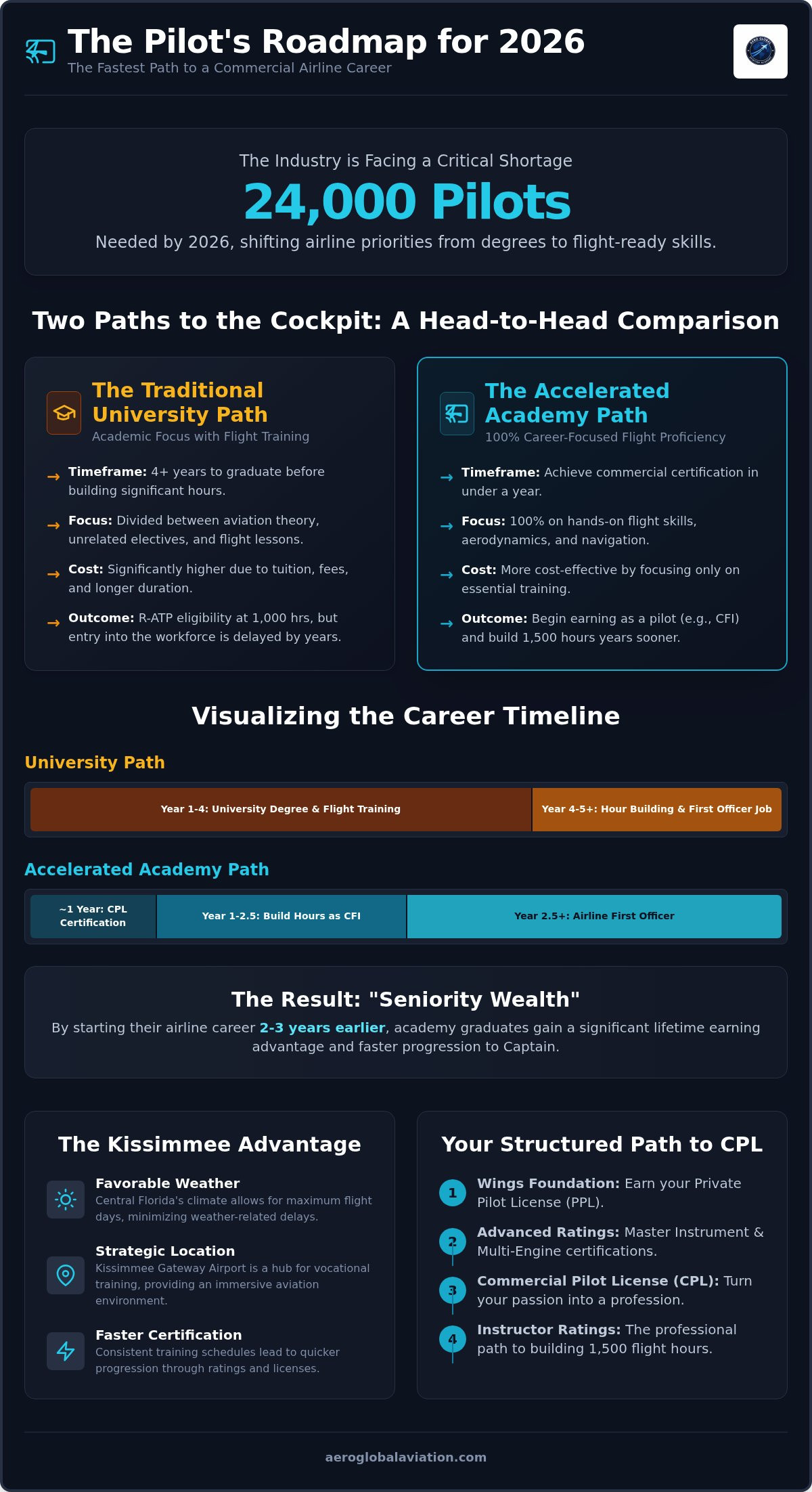
Choosing between a university lecture hall and a flight deck is the first major decision you'll make on your journey to the sky. Traditional university programs bundle flight training with a four-year academic degree, while professional flight academies focus exclusively on the technical skills needed to fly. As you weigh the alternatives to a 4-year aviation degree Kissimmee provides, it's clear that the industry's priorities are shifting. In 2026, the projected shortage of 24,000 pilots has forced airlines to value flight hours and technical proficiency over a bachelor's degree.
Academies operate under Part 141 or Part 61 of the FAA regulations, offering a more immersive environment. Instead of balancing flight lessons with unrelated electives, you spend your days at the airport, living and breathing aviation operations. This skill-first approach ensures that your training is relevant to the cockpit from day one. You're not just a student; you're a pilot-in-training from your very first hour.
The Reality of Airline Degree Requirements in 2026
Major carriers and regional airlines have significantly relaxed their degree mandates to keep up with the global demand for 660,000 new pilots. While a university degree can grant a Restricted ATP (R-ATP) at 1,000 hours, the four-year wait to graduate often delays your entry into the workforce longer than simply building 1,500 hours at an academy. Many pilots now choose to launch their careers through an accelerated program and complete their degree online once they've secured a seat at a regional airline. This strategy allows you to gain seniority and a professional salary years earlier than the traditional path allows.
Academic Rigor vs. Flight Proficiency
Aero Global Aviation Academy maintains high professional standards by treating every lesson as a direct step toward a commercial career. You won't find general education requirements here; instead, you'll focus 100% of your energy on mastering aerodynamics, weather patterns, and advanced navigation. This concentrated effort builds a level of flight proficiency that academic theory alone cannot replicate. You learn the mechanics behind every maneuver while sitting in the cockpit, not just reading about it in a textbook. The FAA certification path remains the primary legal requirement for operating commercial aircraft. By mastering pilot certification in the U.S. through a dedicated academy, you ensure that your training is streamlined, cost-effective, and focused on your ultimate destination. Finding effective alternatives to a 4-year aviation degree Kissimmee offers means looking for programs that prioritize your time and your professional reputation.
Accelerated Career Pilot Programs: The Direct Path in Kissimmee
For students looking for the most efficient alternatives to a 4-year aviation degree Kissimmee provides, accelerated career pilot programs offer a clear, tactical advantage. These programs don't just teach you how to fly; they immerse you in a professional environment that mirrors the daily operations of a commercial airline. By following a structured, syllabus-driven curriculum, you can compress four years of academic study into less than a year of intensive flight training. This approach prioritizes your technical readiness and helps you build a network of mentors and peers who share your professional drive from day one.
At an academy, your training is the priority. You aren't competing with campus events or unrelated degree requirements for aircraft availability. Instead, you're focused on mastering the aircraft and understanding the complex systems required for safe commercial operations. This immersive environment builds the muscle memory and decision-making skills that airlines value most in 2026.
From Wings Foundation to Commercial Certification
Your journey begins with the Wings Foundation course, which focuses on earning your Private Pilot License (PPL). Once you've mastered the basics of flight, you'll transition into advanced ratings like Instrument and Multi-Engine certifications. These are critical milestones that prepare you for the complexities of modern air travel and all-weather operations. The final step in this progression is achieving your Commercial Pilot License (CPL). This certification transforms your passion into a profession, allowing you to legally earn a living in the sky while you work toward your long-term goals.
The Role of the Certified Flight Instructor (CFI) Rating
Building the 1,500 hours required for major airlines is often the biggest hurdle for new pilots. The Certified Flight Instructor (CFI) rating is the most popular way to bridge this gap. Programs like our Airline Pilot Elite track prepare you to become a highly skilled instructor, allowing you to gain valuable experience while helping others realize their dreams. This path offers a massive financial benefit; you get paid to fly while working toward your ultimate goal. With a strong job outlook for pilots projected through 2034, entering the workforce as a CFI ensures you're gaining seniority while others are still in a classroom. If you're ready to see how quickly you can advance, explore our training tracks to find your perfect fit.
Calculating the ROI: Costs and Career Timelines
When you evaluate the financial reality of flight training, the numbers tell a compelling story. Traditional universities often charge out-of-state tuition rates that include thousands for campus amenities and courses that have nothing to do with aviation. By choosing the alternatives to a 4-year aviation degree Kissimmee offers, you're investing directly in your cockpit time. You pay for the fuel, the aircraft, and the instructor's expertise, not for a stadium or a lecture hall. Most academies offer flexible payment plans and partner with specialized lenders to help you manage the cost of your education without the weight of traditional university debt.
The most significant factor isn't just the tuition check; it's the opportunity cost. Every year you spend in a university is a year you aren't earning a professional salary. In the airline industry, seniority is the ultimate currency. It determines your schedule, your aircraft type, and your base. Reaching the flight deck at age 21 instead of 24 can result in millions of dollars in additional lifetime earnings because those three extra years occur at the highest pay scales of your career. Getting into the workforce early is the smartest financial move an aspiring pilot can make.
The 18-Month Timeline to Commercial Pilot
Getting from zero experience to a professional cockpit requires a disciplined schedule. A typical PPL to CPL timeline at an academy usually spans 12 to 18 months, depending on your pace and dedication. In Kissimmee, our students benefit from some of the most consistent flying weather in the country, which minimizes delays and keeps your training momentum high. To stay on track for a 2026 graduation, you need a program that prioritizes aircraft availability and instructor support. This structured approach ensures you aren't waiting weeks for a checkride or a maintenance slot, allowing you to hit your milestones with precision.
Salary Projections and Seniority Benefits
The initial investment in flight training might seem daunting, but the return is rapid. With the median US airline pilot salary reaching $226,600 in 2024, first-year officers at regional airlines are seeing competitive starting pay and signing bonuses that help manage training debt quickly. Understanding how to become a pilot through an accelerated path means you start collecting these checks sooner. Every month of delay in your training costs you thousands in future earnings and pushes you further down the seniority list. By choosing one of the alternatives to a 4-year aviation degree Kissimmee provides, you're securing your future today rather than waiting for a graduation date years away.
Why Kissimmee is the Ideal Hub for Non-Degree Training
Success in flight training depends on your environment as much as your effort. When exploring the alternatives to a 4-year aviation degree Kissimmee offers, you'll find that the local infrastructure is built specifically for pilot development. Unlike massive international hubs where commercial jets take priority, the Kissimmee area provides a specialized ecosystem that favors the student pilot. This regional advantage allows you to maximize your time in the cockpit and minimize the administrative delays common in large university settings. By choosing a local academy, you're placing yourself in a geographic sweet spot that combines professional-grade facilities with a supportive, mentor-driven community.
Central Florida has long been the heart of the flight training world. This isn't just because of the sunshine; it's because the entire region is optimized for aviation logistics. From the availability of maintenance specialists to the density of practice areas, every resource you need to reach the flight deck is within a short flight of your home base. You aren't just a number in a registrar's office here; you're an active participant in a thriving industry hub.
Strategic Training at Kissimmee Gateway Airport
Kissimmee Gateway Airport (ISM) serves as a premier training base because it offers the perfect balance of complexity and efficiency. While nearby Orlando International handles massive airline volume, ISM allows for significantly lower taxi times. This means more of your billable hour is spent practicing maneuvers rather than waiting for clearance on a crowded tarmac. The airport's location provides immediate access to diverse airspace, which is essential for advanced flight training and mastering real-world navigation. You'll gain experience communicating with various air traffic control towers and navigating busy corridors, building the confidence required for commercial operations without the frustration of a saturated international hub.
Living and Training in the Orlando-Kissimmee Area
Choosing an academy over a university often simplifies your living situation. The cost of living in the Kissimmee area is frequently more manageable than the high-density housing or mandatory dormitory fees associated with major college campuses. Beyond the financial savings, the "Orlando weather advantage" is a tangible asset for your timeline. With year-round Visual Flight Rules (VFR) conditions, you'll rarely find your training grounded for weeks at a time due to seasonal storms or snow. This consistency is why Florida produces a significant portion of the world's commercial pilots. Living here also puts you in direct contact with regional airline recruiters who frequently visit the area for industry events and networking meetups. If you're ready to take advantage of this strategic location, apply to Aero Global Aviation Academy and start your journey today.
Choosing Your Path: Is Aero Global Aviation Academy Right for You?
Deciding where to complete your training is a choice that shapes your entire professional reputation. While we've discussed the logistical and financial benefits of skipping the traditional university route, the final decision comes down to the quality of the mentorship you'll receive. When you evaluate the alternatives to a 4-year aviation degree Kissimmee provides, look closely at the culture of the flight school. At Aero Global Aviation Academy, we don't treat you like a student ID number in a registrar's database. We operate as a dedicated local partner, providing a personalized environment where your progress is the primary metric of our success.
Our facility at the Kissimmee Gateway Airport is designed for students who are ready to immerse themselves in professional flight operations immediately. Before committing to a path, it's vital to perform your own due diligence. We encourage you to review the Best Flight Schools in Florida checklist to compare our instructor-to-student ratios and fleet maintenance standards against other programs. You'll find that our commitment to modern technology and individual attention creates a training experience that large, impersonal university programs simply can't replicate.
The Airline Pilot Elite Experience
For those aiming for the most prestigious flight decks, our Airline Pilot Elite program offers the most comprehensive curriculum available. This track is designed to take you from your first hour all the way to advanced instructor ratings, ensuring you have the credentials to stand out in a competitive hiring market. We focus on building the leadership and decision-making skills required for the Commercial Pilot Career Path. You'll gain experience in complex aircraft and master the crew coordination techniques that major airlines expect from their new hires in 2026.
Take the First Step: Discovery Flights and Enrollment
If you're still weighing the alternatives to a 4-year aviation degree Kissimmee has available, the best way to gain clarity is to experience the cockpit for yourself. A discovery flight is more than just a scenic tour; it's your first lesson and an opportunity to interview your potential instructors. You'll get a feel for our aircraft and see firsthand how our "Practical Mentor" approach works in real-time. Enrollment for our upcoming 2026 terms is now open, and our team is ready to help you secure financing and plan your training milestones. Don't let your career wait for a graduation ceremony years away. Schedule your tour of Aero Global Aviation Academy today! and take control of your future in the sky.
Ready to Trade the Classroom for the Cockpit?
Choosing a vocational path is a strategic investment in your future seniority. By exploring the alternatives to a 4-year aviation degree Kissimmee offers, you're selecting a route that prioritizes technical proficiency and puts you in a commercial seat years ahead of schedule. You've learned how specialized training allows you to focus 100% of your energy on flight operations while leveraging Central Florida's superior weather conditions. This efficiency is the key to meeting the 2026 pilot demand with confidence and skill.
Aero Global Aviation Academy stands ready as your dedicated local partner. Our Career Pilot Program provides the structured curriculum you need to move from zero experience to a professional rating. With our Kissimmee-based training facility and expert CFI mentorship, you'll receive the personalized attention that large universities simply can't match. Don't let a four-year academic delay stand between you and your professional goals.
Start your journey to the flight deck with Aero Global Aviation Academy and secure your place in the sky. Your future is clear and the horizon is wide open.
Frequently Asked Questions
Do I need a college degree to fly for a major airline in 2026?
No, you don't strictly need a four-year degree to fly for major airlines in 2026. While some major carriers still prefer them, the massive pilot shortage has led many to drop the requirement in favor of flight hours and technical proficiency. Most regional airlines hire pilots with a high school diploma and the required flight certifications, allowing you to start your career and gain seniority much earlier than peers stuck in a classroom.
How much faster is a flight academy than a 4-year aviation degree?
A professional flight academy is significantly faster, often taking just 6 to 12 months to reach commercial certification. In contrast, a university program requires four years of academic study alongside flight training. By choosing alternatives to a 4-year aviation degree Kissimmee academies provide, you can enter the workforce and start building your 1,500 hours as a flight instructor years before a university student even reaches their graduation date.
Can I get financial aid for a flight school in Kissimmee?
Yes, financial assistance is available through several specialized channels for students in the Kissimmee area. While federal student loans are typically reserved for degree-granting institutions, many flight schools partner with private lenders to offer competitive aviation loans. Additionally, some academies provide internal payment plans or access to industry-specific scholarships and grants designed to help aspiring pilots manage the cost of their training without the heavy burden of traditional university tuition.
What is the difference between Part 61 and Part 141 training?
The primary difference lies in the structure and flexibility of the curriculum. Part 141 programs follow a strict, FAA-approved syllabus with more oversight, which is ideal for career-oriented students looking for a structured path. Part 61 training is more flexible and can be tailored to an individual's unique schedule. Both paths lead to the same pilot certificates, but Part 141 is often preferred by those seeking an accelerated environment similar to airline operations.
Will I earn the same salary if I don’t have an aviation degree?
Yes, your salary in the airline industry is determined by your rank, aircraft type, and years of seniority rather than your academic background. An airline captain without a degree earns the same contract-mandated pay as one with a doctorate. In fact, starting your career early through alternatives to a 4-year aviation degree Kissimmee programs can lead to higher lifetime earnings by helping you reach the top of the pay scale much sooner.
What happens if I fail my medical exam without a degree to fall back on?
Failing a medical exam is a concern for all pilots, but a degree isn't the only safety net available. Many pilots choose to pursue a degree online after they start flying, or they use their technical aviation knowledge to transition into roles like flight dispatch or safety consulting. Your commercial pilot experience remains a valuable asset in the broader aerospace industry even if you're temporarily grounded from flying as a primary career.
Can I finish my degree online while working as a pilot?
Absolutely, and this is a highly recommended strategy for many modern pilots. Several universities offer bridge programs specifically for active commercial pilots to earn college credits for their existing flight ratings. This allows you to gain seniority and earn a professional salary at a regional airline while completing your bachelor's degree at your own pace. It's a practical way to balance a thriving career with your long-term educational goals.
Why is Kissimmee considered a top location for flight training?
Kissimmee is a premier hub because it offers nearly 360 days of flyable weather per year, ensuring your training stays on schedule. The Kissimmee Gateway Airport provides a professional environment with lower taxi times compared to busy international hubs, which maximizes your actual flight time. Its proximity to Orlando also gives you access to a massive aviation network, including major airline recruiters and diverse airspace for mastering advanced training scenarios.


