
In the 2026 aviation market, the best pilot trade school isn't necessarily the one with the most airplanes; it's the one that treats your career as a tangible destination rather than just a series of lessons. You've likely felt the weight of information overload while searching for a trade school for pilots Orlando, wondering if you'll truly be "airline ready" after graduation. It's natural to feel overwhelmed by high training costs and the confusing technical jargon surrounding flight regulations. You want a clear, reliable route to the flight deck without the cold, clinical feel of a massive national corporation.
We understand that your goal isn't just to fly, but to build a professional life in the sky. This guide will help you evaluate the local training landscape and choose a vocational path that leads directly to airline employment. We'll explore how to move from your first solo to a Commercial Pilot License with confidence. You'll discover why the strategic environment of Kissimmee offers a unique advantage for your training efficiency and how specialized tracks like the Airline Pilot Elite program provide the high-touch mentorship required to transition into a professional cockpit. Let's map out your journey to the airlines.
Key Takeaways
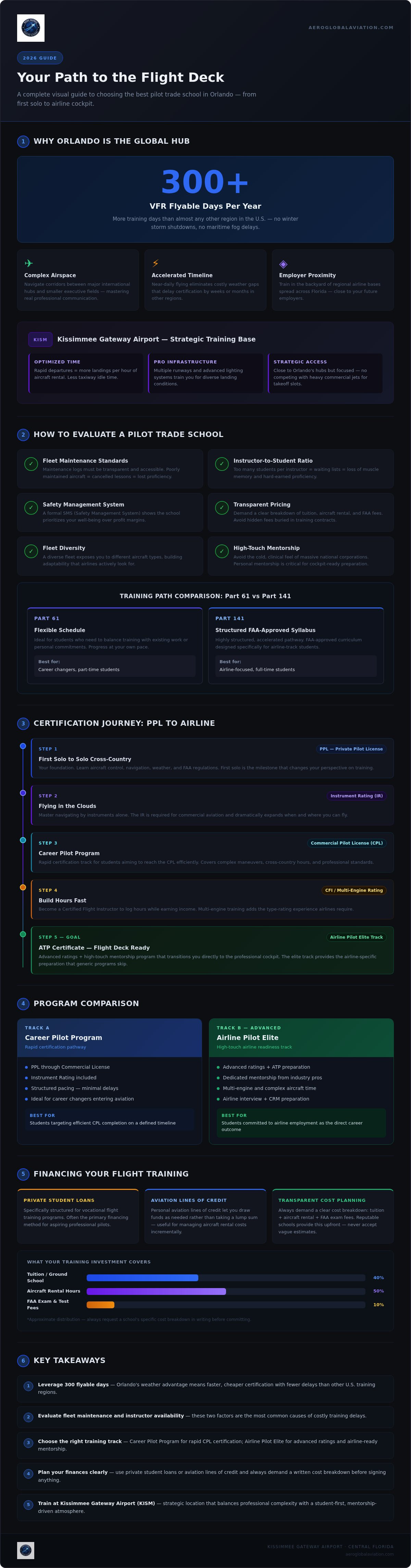
- Leverage Orlando's 300 days of flyable weather and complex airspace to build superior skills more efficiently than in other regions.
- Learn how to evaluate a trade school for pilots Orlando by focusing on fleet maintenance standards and instructor availability to avoid common training delays.
- Select the training track that fits your career goals, whether it is the Career Pilot Program for rapid certification or the Airline Pilot Elite track for advanced ratings.
- Gain clarity on financing your education through private student loans and personal aviation lines of credit to manage your total investment effectively.
- Discover the benefits of training at Kissimmee Gateway Airport, where a personalized mentorship approach prepares you for the professional flight deck.
Why Orlando is the Global Hub for Pilot Trade Schools
Orlando has earned its reputation as the global epicenter for flight training, and for good reason. When you look for a trade school for pilots Orlando, you aren't just choosing a classroom; you're choosing an environment that accelerates your transition from the ground to the flight deck. Central Florida combines high-quality infrastructure with a professional ecosystem that mirrors the airline industry. The region's airspace is uniquely designed to challenge and refine your skills. Navigating the corridors between major international hubs and smaller executive fields ensures that by the time you reach your commercial checkride, you've already mastered the communication and situational awareness required of a professional aviator. Plus, being in close proximity to regional airline bases across Florida means you're training in the backyard of your future employers.
The Weather Factor: Maximizing Flight Hours
Consistency is the most valuable asset in flight training. Orlando offers over 300 days of Visual Flight Rules (VFR) weather every year, which means your schedule remains predictable. In other parts of the country, a student might lose weeks to winter storms or heavy maritime fog. Here, you can fly almost every day. This reliability directly impacts your timeline, allowing you to move through the Career Pilot Program without the frustration of constant weather cancellations. It's why students from around the world choose this region for accelerated vocational training. When you don't have to worry about the sky being closed, you can focus entirely on mastering your craft.
Kissimmee Gateway Airport: A Strategic Training Base
Location is a strategic training asset. Training at Kissimmee Gateway Airport (KISM) provides a professional environment without the overwhelming congestion of Orlando International (MCO). You spend less time idling on the taxiway and more time in the air practicing maneuvers. KISM serves as a dedicated base for executive and training flights, offering a balance of complexity and accessibility. Choosing a trade school for pilots Orlando that operates out of a strategic base like Kissimmee ensures that every dollar of your tuition translates into active flight experience.
- Optimized Training Time: Rapid departures mean more landings per hour of aircraft rental.
- Professional Infrastructure: Multiple runways and advanced lighting systems prepare you for diverse landing conditions.
- Strategic Access: You stay close to Orlando's aviation hubs while enjoying a focused, student-centric atmosphere.
By training at a dedicated executive airport, you gain the confidence to operate in busy environments without the stress of competing with heavy commercial jet traffic for every takeoff slot. This creates a more efficient path to your Commercial Pilot License and ensures you're ready for the pace of professional aviation.
Evaluation Criteria: Choosing the Best Pilot Trade School in Orlando
Selecting the right trade school for pilots Orlando requires a critical eye that looks past shiny brochures and focuses on operational reality. You need to ensure the school's fleet is not only diverse but maintained to the highest standards. In a professional hangar, maintenance logs should be transparent and accessible. Consistent upkeep prevents the frustration of showing up for a lesson only to find the aircraft grounded. Similarly, ask about instructor-to-student ratios. If a school has too many students and not enough instructors, you'll find yourself trapped on a waiting list, losing the muscle memory and proficiency you worked so hard to build.
Safety culture is another non-negotiable factor. Look for schools that implement a formal Safety Management System (SMS). This structured approach to risk management shows the school prioritizes your well-being over profit. When it comes to financing, demand transparent pricing. Professional training involves tuition, aircraft rental, and FAA fees. A reputable partner will provide a clear breakdown of these costs upfront, helping you avoid the hidden fees that often plague flight training contracts.
Structured vs. Flexible Training Paths
Your choice between Part 61 and Part 141 training depends entirely on your personal schedule and career goals. While Part 141 offers a highly structured, FAA-approved syllabus ideal for those aiming for the airlines, Part 61 provides a flexible path for those who need to pace their training around other commitments. For most full-time students, a career pilot program is the most efficient choice. This structured vocational route aligns your daily training with modern airline standards, ensuring you're building the specific skills regional carriers look for in new hires.
The Mentorship Factor: More Than Just an Instructor
The best training environments offer more than just technical instruction; they provide mentorship. In a "pilot factory" setting, you're often just a number in a logbook. A high-touch trade school for pilots Orlando focuses on personalized attention, which significantly reduces the "washout" rate. When your instructor acts as a practical mentor, they don't just teach you how to fly; they teach you how to think like a captain. This includes career counseling and professional development that extends beyond the cockpit. If you're ready to start this journey with a team that values your individual success, exploring our academy's approach is a great first step toward your professional goals.
Comparing Professional Pilot Programs: From PPL to Elite Certification
Selecting a trade school for pilots Orlando means choosing a specific pathway that transforms your ambition into professional certification. Your journey is unique, but the industry demands a specific set of skills that we've structured into cohesive programs. It starts with the Wings Foundation, where you build a rock-solid Private Pilot base. This foundation is essential for everything that follows. From there, you progress through more complex ratings that prepare you for the high-stakes demands of a commercial cockpit. We view these programs not just as courses, but as tangible destinations on your career map.
The Career Pilot Program: PPL to CPL
The transition from private flying to commercial pilot training is where your professional habits truly take root. This program serves as the direct route from zero hours to your Commercial certification. A critical milestone in this phase is the Instrument Rating (IR). In Central Florida, weather can shift rapidly; mastering IR ensures you can fly safely and professionally in diverse conditions. You'll also spend significant time building cross-country hours. These flights aren't just about distance. They're about managing complex systems and making captain-level decisions across multiple airspaces, ensuring you're ready for the pace of professional aviation.
The Elite Path: Becoming a Certified Flight Instructor (CFI)
For those who want to reach the airlines as quickly as possible, the Airline Pilot Elite program is the gold standard. It integrates instructor ratings into your training, allowing you to stay at your trade school for pilots Orlando as a CFI. It's the most efficient way to bridge the gap toward the 1,500-hour requirement for regional airlines. Teaching others reinforces your own knowledge and builds the leadership skills that airline recruiters value most. This collaborative spirit is what separates a student from a professional.
In the 2026 hiring market, diversity in your logbook is essential. The Elite path includes Multi-Engine ratings, which are vital for transitioning to larger jets. Utilizing advanced flight training ensures that when you hit that 1,500-hour mark, you're not just a pilot with a lot of time. You're a highly qualified professional ready for a type rating. We focus on making this transition feel logical, rewarding, and entirely within your reach.
- Wings Foundation: Your first step, focusing on the fundamentals of flight and safety.
- Career Pilot Program: The vocational core that takes you to a professional license.
- Airline Pilot Elite: The comprehensive track designed to make you a mentor and a leader in the industry.
Financing Your Pilot Trade School Education
Investing in your future at a trade school for pilots Orlando is a significant decision that requires a clear financial strategy. While the initial investment is substantial, it's helpful to view these costs as the price of entry into a high-yield professional career. A comprehensive training budget includes more than just tuition; you must account for aircraft rental hours, fuel surcharges, and FAA examiner fees. By understanding these components upfront, you can avoid the stress of unexpected expenses and focus entirely on your progression toward the flight deck. In the 2026 market, first-officer salaries at regional airlines continue to show a strong return on investment, making the transition from student to professional both logical and rewarding.
Most students utilize a combination of funding sources to maintain their training momentum. Private student loans designed specifically for flight training are a common choice, often offering deferred payment options until you reach a hiring milestone. Alternatively, personal aviation lines of credit provide flexibility, allowing you to pay for hours as you fly. We recommend structuring your payments to ensure you never have to pause your training, as consistency is the primary driver of cost-efficiency in flight school. If you're ready to see a transparent breakdown of how to fund your journey, speak with our admissions team to explore your specific options.
Scholarships and Grants in Aviation
You don't have to carry the entire financial burden alone. Many organizations are dedicated to supporting the next generation of aviators through grants and scholarships. Local Florida aviation chapters often provide funds specifically for students attending a trade school for pilots Orlando. Additionally, national organizations like the Aircraft Owners and Pilots Association (AOPA) and the Experimental Aircraft Association (EAA) offer annual scholarship cycles. To build a competitive application, focus on demonstrating your commitment to the field through volunteer work or local aviation club participation. These funds can significantly offset the cost of advanced ratings.
Maximizing Your Training Budget
Efficiency is the secret to saving money during flight school. Completing your private pilot license florida in an environment with consistent weather prevents the "dead time" that leads to expensive retraining. Every hour you spend in the cockpit should be purposeful and guided by a structured syllabus. We also encourage the strategic use of high-quality flight simulators. Simulators allow you to practice complex instrument procedures at a fraction of the hourly cost of an aircraft, ensuring you're fully prepared before you ever leave the ground. By combining local weather advantages with modern technology, you can reach your commercial goals without overextending your budget.
Why Aero Global Aviation Academy is Orlando's Premier Choice
Choosing a trade school for pilots Orlando is about finding a dedicated partner, not just a training provider. We don't operate like a national "pilot factory" where you're just a tail number on a spreadsheet. Instead, we embrace a Practical Mentor philosophy. This means your success is personal to us. Our instructors are deeply invested in your journey from your first takeoff to your final commercial checkride. We provide a professional environment designed specifically for career pilots, featuring a modern fleet and a culture of excellence that mirrors the standards of major airlines. Every aspect of our academy is built to transition you from a student to a confident, airline-ready professional.
The Aero Global Advantage in Kissimmee
Our location at Kissimmee Gateway Airport is a strategic asset for your training efficiency. By avoiding the heavy congestion of larger international hubs, we ensure you spend more time in the air and less time waiting on the taxiway. This student-centric approach is the foundation of our structured airline pilot career path. We've designed every program to be a logical progression toward your professional goals. Local career changers and aspiring aviators choose us because we offer vocational excellence without the impersonal feel of massive national chains. Our Airline Pilot Elite track provides a comprehensive roadmap that doesn't just stop at a license; it prepares you for the high-stakes environment of the majors.
Take the First Step: Discovery Flights and Enrollment
The path to the professional flight deck starts with a single decision. If you're curious about what it feels like to sit in the captain's seat, a discovery flight at Aero Global is the perfect introduction. During this flight, you'll take the controls under the guidance of one of our expert mentors, gaining a true sense of the aircraft and our training style. It's an opportunity to see our facility, inspect our fleet, and meet the team that will support your 2026 Career Pilot Program journey. We want you to feel the excitement and the professionalism that defines our academy before you commit to your full training path.
Our enrollment process for upcoming intakes is straightforward and supportive. We guide you through every requirement, from medical certificates to financing options, ensuring you're ready for day one. Don't let another year pass by wondering what your life could look like in the clouds. You can book your tour of our Kissimmee facility today and discover why we are the preferred trade school for pilots Orlando. Let's turn your aviation aspirations into a tangible career destination together.
Your Future in the Flight Deck Starts Today
The journey to becoming a professional pilot is a structured, rewarding process that requires the right environment and guidance. You have seen how Orlando's consistent weather and complex airspace serve as a premier training ground for those who are serious about their aviation career. By choosing a trade school for pilots Orlando that prioritizes personalized mentorship over high-volume throughput, you ensure that every hour in the cockpit builds the specific skill set required by major airlines. It is about more than just logging hours; it is about developing the mindset of a captain.
Whether you start with the Wings Foundation or pursue our advanced PPL to Instructor Elite tracks, our location at Kissimmee Gateway Airport provides the strategic advantage you need to reach your 1,500-hour goal efficiently. We are here to act as your practical mentor, turning complex certifications into a tangible career destination. The sky is not a limit; it is your future workplace. We are ready to help you navigate the path to your professional wings and join the next generation of aviators. It is time to stop researching and start flying.
Start Your Journey: Explore Our Career Pilot Programs
Frequently Asked Questions
Is a pilot trade school better than a four-year aviation degree?
A vocational path is often superior for those prioritizing speed and specialized technical training. While a degree offers a broad academic background, a trade school for pilots Orlando focuses exclusively on the flight hours and certifications needed for airline hiring. You'll enter the workforce years earlier, allowing you to start earning a professional salary while your peers are still in the classroom. It is a direct, efficient route to the cockpit.
How long does it take to finish a career pilot program in Orlando?
Completion times vary based on your pace, but a dedicated student in our Career Pilot Program can typically move from zero hours to Commercial certification in 10 to 14 months. Orlando's consistent flying weather prevents the seasonal delays common in northern states. This accelerated timeline is designed for full-time students who want to transition into a professional aviation career as quickly and safely as possible.
What are the prerequisites for enrolling in an Orlando flight school?
To begin your professional training, you must be at least 18 years old for commercial certification and hold a high school diploma or equivalent. You'll also need to obtain an FAA Medical Certificate to ensure you meet the physical requirements for flight. Proficiency in the English language is mandatory for all pilots. We recommend completing these steps before your first lesson to ensure a smooth transition into the Wings Foundation course.
Can I get financial aid for pilot trade school in Florida?
While traditional federal student aid is often restricted to degree-granting institutions, many private lenders offer specialized flight training loans for vocational students. You can also apply for local Florida scholarships or national grants from organizations like AOPA and EAA. We encourage students to explore these options early to maintain training momentum. Our team can provide guidance on structuring your budget to cover tuition, aircraft rentals, and FAA examination fees.
What is the difference between Part 61 and Part 141 training?
The primary difference lies in the structure and oversight of the curriculum. Part 141 programs follow a strict, FAA-approved syllabus that is ideal for those pursuing a career with the airlines. Part 61 training offers more flexibility, allowing you to pace your lessons around a personal schedule. Both paths lead to the same pilot certificates, but the structured environment of a Part 141 school often provides a more predictable timeline for graduation.
Do I need a college degree to fly for a major airline in 2026?
In the 2026 hiring market, a four-year college degree is no longer a strict requirement for many major airlines, and it is rarely required for regional carriers. Airlines now prioritize flight experience, specialized ratings, and a clean safety record. Completing an advanced track like our Airline Pilot Elite program demonstrates the professional discipline and technical mastery that recruiters value most. Your focus should be on building high-quality flight hours and professional mentorship.
Why is Kissimmee Gateway Airport a popular choice for student pilots?
Kissimmee Gateway Airport offers a strategic balance of professional infrastructure and manageable traffic levels. Unlike the congestion at Orlando International, Kissimmee allows you to spend more time practicing maneuvers and less time idling on the taxiway. This efficiency makes it an ideal home for a trade school for pilots Orlando. You'll learn to navigate complex airspace while enjoying the support of a dedicated executive airport environment designed for student success.
What is the average salary for a commercial pilot starting in 2026?
Salaries for new commercial pilots have seen steady growth due to the ongoing demand for qualified flight crews. While specific earnings depend on the airline and aircraft type, starting first officers at regional carriers can expect competitive compensation packages that often include signing bonuses. This strong ROI makes the initial investment in vocational training a logical choice for career changers. We focus on preparing you for these high-yield opportunities through rigorous, career-aligned certification programs.


