
Spending four years in a university lecture hall might actually delay your arrival at a major airline cockpit by nearly two years. While some still believe a bachelor's degree is a mandatory requirement for professional pilots, the reality of the 2026 hiring market is far more accessible. You don't need to spend $300,000 on a degree to secure a seat at a regional or major carrier. Instead, many aspiring aviators are finding a faster, more cost-effective path through a flight school without a college degree Orlando, where the focus stays on high-intensity, practical training rather than general education credits.
We understand the anxiety of worrying if you'll be filtered out by HR or if the return on investment truly justifies the cost of your training. You want a clear roadmap that respects your time and your professional ambitions. This guide will show you how to launch your career through structured pathways like our Career Pilot Program or the Airline Pilot Elite track. You'll discover the "seniority math" that puts academy graduates in the workforce sooner, a step-by-step roadmap from zero experience to the flight deck, and why Orlando’s 300 days of annual sunshine make it the premier destination for your training.
Key Takeaways
- Understand why major airlines in 2026 have shifted toward skills-based hiring, prioritizing your flight hours and safety record over a traditional four-year diploma.
- Learn the specific FAA requirements for commercial certification and how to bridge the gap between being "legal to fly" and "competitive for hire" in today's market.
- Discover how a flight school without a college degree Orlando can get you into a professional cockpit in just 12 to 18 months, significantly faster than a university program.
- Explore the strategic advantages of training in Orlando’s complex airspace and Kissimmee’s consistent weather to maximize your efficiency and year-round flight hours.
- Identify the right training path for your goals, whether you choose the focused Career Pilot Program or the comprehensive Airline Pilot Elite track for advanced certification.
The Reality of Flight School Without a College Degree in 2026
The aviation industry has undergone a massive transformation that favors your ambition over a traditional university transcript. For decades, a four-year degree was the gatekeeper to a major airline cockpit. Today, that gate is wide open. Airlines now prioritize technical proficiency, safety records, and logged flight hours. If you're looking for a flight school without a college degree Orlando, you're positioning yourself at the forefront of a skills-based hiring revolution. This shift allows you to focus your energy and resources on the specific skills required to command a modern aircraft.
The 2026 Industry Shift: Why Degrees Are No Longer Mandatory
Major legacy carriers like Delta, United, and American have officially reclassified the bachelor's degree from a mandatory requirement to a preferred qualification. This change stems from a persistent pilot shortage and a realization that academic coursework doesn't always correlate with flight deck performance. Regional airlines, which serve as the primary entry point for new commercial pilots, have almost entirely removed degree requirements from their hiring criteria. They want pilots who have mastered the nuances of pilot certification in the United States through rigorous, hands-on training. Vocational academies provide exactly what these recruiters seek: targeted expertise and a high volume of flight hours in complex airspace. You'll enter the interview room with the exact certifications and real-world experience they need to see.
The Seniority Advantage of Starting Early
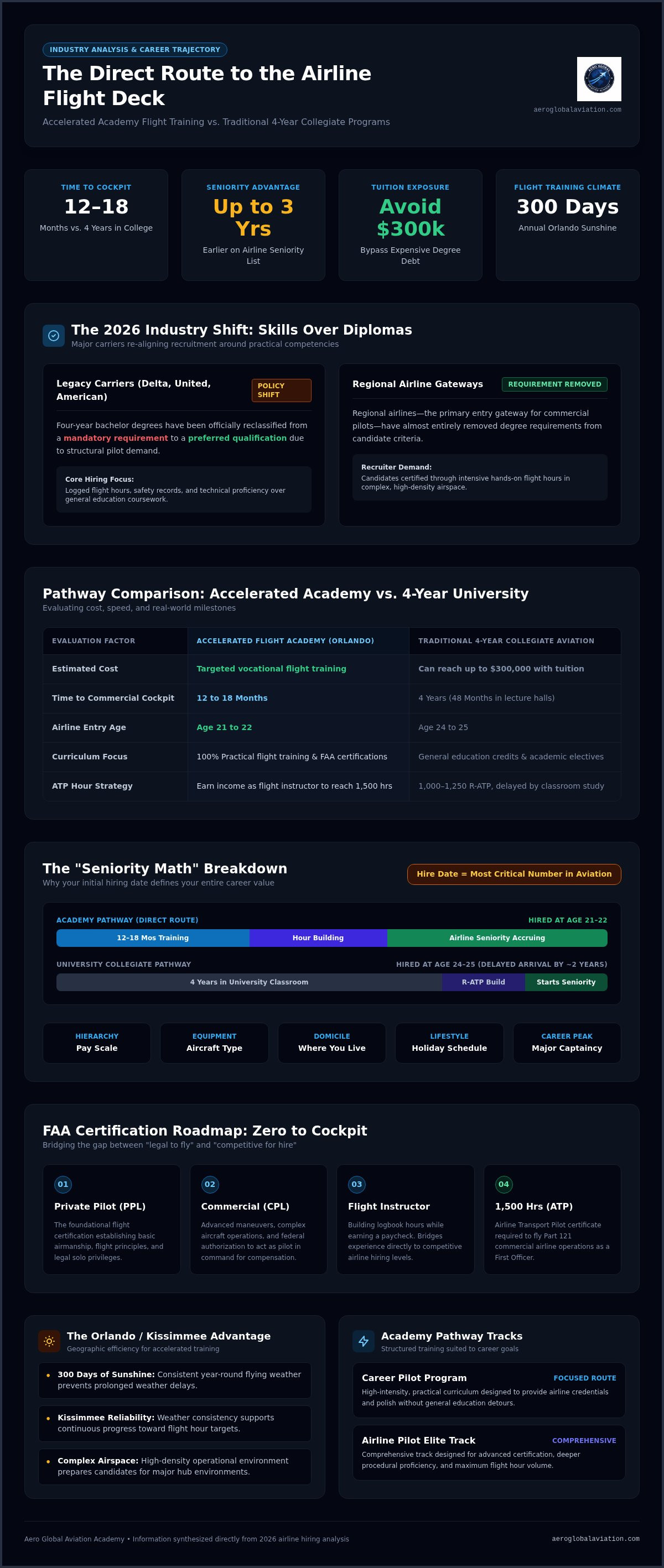
In the airline world, your date of hire is the most important number in your life. Seniority determines your pay scale, which aircraft you fly, where you live, and even your holiday schedule. By choosing an accelerated flight school without a college degree Orlando, you can reach the 1,500-hour milestone significantly faster than your peers in four-year collegiate programs. You aren't just saving time; you're gaining a massive head start on the seniority list.
Consider the opportunity cost of waiting. A student in a university program might not hit the regional airline seniority list until age 24 or 25. An academy student can often start their career by age 21 or 22. Those three extra years at the end of your career, when you're likely a Captain at a major airline, could represent millions of dollars in lost lifetime earnings. Starting early isn't just about getting to work. It's about securing your financial future and lifestyle earlier than you ever thought possible.
Choosing this path doesn't mean you're taking a shortcut. It means you're taking the most direct route to your destination. Programs like our Career Pilot Program are designed to provide the specific credentials and professional polish that airlines demand. You'll be ready for the flight deck without the detour of general education classes, focusing entirely on the high-stakes world of professional aviation.
FAA Requirements vs. Airline Hiring Standards
Understanding the difference between what is legally required and what makes you employable is the first step toward your new career. The FAA pilot certification requirements provide the legal framework for every aviator in the country. However, meeting the minimum legal standard to fly a plane isn't the same as being competitive for a seat at a regional airline. While a flight school without a college degree Orlando focuses on these federal standards, a high quality program ensures you exceed them to meet the rigorous expectations of modern carriers.
One of the most misunderstood aspects of the industry is the Airline Transport Pilot (ATP) certificate. To fly for a Part 121 airline, you generally need 1,500 total flight hours. While university graduates can qualify for a "Restricted ATP" at 1,000 or 1,250 hours, they spend four years in a classroom to get that 500 hour reduction. In contrast, students in a structured career pilot program often reach the full 1,500 hour mark faster by working as flight instructors. You'll be earning a paycheck while your collegiate peers are still studying for midterms, putting you on the seniority list much sooner.
The Path from PPL to CPL
Your journey begins with the Private Pilot License (PPL), which allows you to fly solo and carry passengers. But to get paid to fly, you must earn your Commercial Pilot License (CPL). This is the professional baseline. It requires more precision, deeper systems knowledge, and a higher level of airmanship. For a detailed breakdown of this transition, check out our Commercial Pilot Training Guide. We'll help you master the maneuvers and regulations needed to turn your passion into a profession.
Beyond the License: Ratings That Matter
A license alone isn't enough to secure a professional job. You need specific ratings to be "airline ready." The Instrument Rating allows you to fly in clouds and low visibility, while the Multi-Engine Rating proves you can handle complex, high performance aircraft. These technical credentials carry far more weight with airline recruiters than a general education degree. You can explore these critical milestones in our Advanced Flight Training Guide. If you're ready to take the first step, you can explore our training pathways to see which course fits your timeline.
Comparing Flight Academies to Collegiate Aviation Programs
Choosing between a university degree and a vocational academy is often the biggest decision a student pilot faces. In the Orlando area, you have access to both, but the outcomes are vastly different. A collegiate program typically takes 48 months to complete, whereas an academy like Aero Global can take you from zero experience to a commercial certificate in just 12 to 18 months. This speed is possible because our curriculum is 100% aviation-centric. You won't spend time or money on general education requirements that have nothing to do with your goal of reaching the flight deck. By selecting a flight school without a college degree Orlando, you're choosing a specialized environment where every hour spent is an investment in your technical proficiency.
Networking is another area where local academies shine. Being situated in the Orlando aviation hub means you're training alongside active industry professionals and recruiters. You aren't just a number in a large lecture hall; you're a recognizable face at the airport. This proximity provides direct access to the local aviation community, allowing you to build the professional relationships that often lead to your first job as a flight instructor or charter pilot.
The "Fast-Track" Academy Philosophy
Immersion is the secret to mastery in aviation. When you fly five days a week, your skill retention is significantly higher than a student who only flies once or twice between academic classes. We act as your Practical Mentor, providing the personalized attention needed to navigate complex training milestones. The airline pilot career path favors the focused student who can demonstrate consistent, high-level performance. Our structured programs ensure you're always moving toward your next rating without the distractions of a traditional campus lifestyle.
The Hidden Costs of the University Route
The financial difference between these two paths is stark. While vocational flight academies generally range from $80,000 to $110,000 for a full pathway, a private collegiate aviation degree can exceed $300,000 when you factor in tuition, housing, and flight fees. According to the Bureau of Labor Statistics airline and commercial pilot outlook, the entry-level requirements for commercial pilots don't mandate these expensive degrees. Heavy student loan debt can also cripple your early-career flexibility. By entering the workforce up to two years earlier, you're earning a salary and building seniority while university students are still paying for elective courses. This head start is a powerful advantage in a seniority-based industry.
Key Factors for Selecting an Orlando Flight School
Selecting the right flight school without a college degree Orlando requires looking beyond the marketing brochures. You need a training ground that prepares you for the high-pressure environment of a commercial flight deck from day one. Orlando offers a unique strategic advantage because of its layered and complex airspace. Training at an airport like Kissimmee Gateway (KISM) places you right under the shelf of Orlando International's (MCO) Class B airspace. This means you'll learn to navigate radar handoffs and busy tower communications as part of your standard routine. This early exposure builds the radio confidence that regional airline recruiters prioritize during the hiring process.
Why Training in Kissimmee/Orlando is a Strategic Choice
Central Florida averages over 300 flyable VFR (Visual Flight Rules) days per year. This consistency is a massive asset for students who want to reach the 1,500-hour milestone without being grounded by seasonal weather patterns found in the North or Midwest. While the sunshine keeps you in the air, the afternoon thermals common in Florida build superior stick-and-rudder skills. You'll learn to handle varied atmospheric conditions that a classroom simply can't simulate. To help you narrow down your options, we've developed a Best Flight Schools in Florida Checklist to guide your search.
The Importance of a Structured Career Pilot Track
You aren't training for a weekend hobby; you're training for a professional life. It's vital to vet a school’s syllabus to ensure it's designed for career progression. Look for academies that prioritize modern glass cockpit training, such as the Garmin G1000 system, which mirrors the technology you'll find in regional jets. Reliable aircraft availability is also critical. Onsite maintenance teams ensure that planes stay in the air rather than waiting for parts. If you're just starting your journey, our guide on how to get your PPL in Florida provides the perfect roadmap for those initial hours.
When you visit a potential school for a discovery flight, use this quick checklist to evaluate their operations:
- Maintenance Standards: Does the school have its own mechanics and a clean hangar?
- Fleet Modernity: Are the aircraft equipped with the avionics used by modern airlines?
- Instructor Availability: What's the student-to-instructor ratio? You don't want to wait weeks for a lesson.
- Atmosphere: Does the environment feel like a professional academy or a casual flying club?
The right partner will act as your practical mentor, guiding you through every checkride with confidence. If you're ready to experience a professional training environment, schedule a tour of Aero Global Aviation Academy today.
Launching Your Career with Aero Global Aviation Academy
At Aero Global Aviation Academy, we don't just teach you how to fly; we prepare you for a lifelong career. Choosing a flight school without a college degree Orlando means you're prioritizing practical excellence over academic theory. Our team serves as your Practical Mentor. We provide the one-on-one attention that large universities often overlook. We believe that your success is our success. We've structured our programs to reflect the high-stakes reality of professional aviation while maintaining a supportive, student-centric atmosphere.
The Career Pilot Program: Zero to Hero in Orlando
Our Career Pilot Program is the definitive alternative to a four-year degree, offering a streamlined, high-intensity pathway directly to commercial certification. You'll start with the fundamentals and progress through advanced maneuvers, complex systems knowledge, and professional standards. We manage the hour-building process with a focus on quality. Every minute in your logbook contributes to your growth as a professional. This program is designed specifically for those who want to reach the flight deck with speed and precision. It's the most direct route to transforming your passion into a paycheck without the four-year detour. By choosing a flight school without a college degree Orlando, you're taking control of your timeline and your future.
Airline Pilot Elite: The Ultimate Credential
For those aiming for the highest level of professional credentials, the Airline Pilot Elite track is the gold standard. This program takes you beyond the commercial certificate by adding instructor ratings like CFI and CFII. Becoming an instructor is the most effective way to bridge the gap to 1,500 hours. You'll refine your own skills through teaching while earning a salary. Training in Kissimmee with our dedicated team gives you a front-row seat to the industry. You'll build your hours in the same complex airspace used by the majors, ensuring your transition to the airlines is seamless and confident.
If you're brand new to the cockpit, your journey begins with our Wings Foundation course. Here, you'll earn your Private Pilot License and build the core skills needed for advanced training. From that first solo flight to your final checkride, we're with you every step of the way. We invite you to join a community of aviators who value skill, safety, and regional pride. Your career doesn't need a four-year degree; it needs a clear destination and the right partner to help you reach it. Let's get started on your journey to the flight deck today.
Take Command of Your Aviation Future
The 2026 aviation market belongs to pilots who prioritize technical proficiency and logged hours over traditional four-year diplomas. By choosing a flight school without a college degree Orlando, you're embracing the fastest route to the flight deck and securing your place on the seniority list years ahead of your peers. You've seen how the industry has shifted toward skills-based hiring and how the geographic advantages of Kissimmee can accelerate your training timeline.
Aero Global Aviation Academy is here to act as your practical mentor. We provide personalized instruction and proven PPL to CPL career tracks designed for your individual success. Our Kissimmee-based training ensures you maximize your flyable days in a professional, high-stakes environment that prepares you for the majors. Your dream of a professional pilot career doesn't need to wait for a university graduation. Start Your Career Pilot Journey at Aero Global Today and take the first step toward your new destination. The sky is waiting for you.
Frequently Asked Questions
Do major airlines like Delta or American still require a degree in 2026?
Major airlines like Delta and American don't require a four-year degree in 2026. While they may list a degree as a preferred qualification, they've shifted their focus toward flight hours, safety records, and technical proficiency. This change allows skilled aviators to enter the major airline workforce based on their performance in the cockpit rather than their time in a traditional college classroom.
Can I get a student loan for flight school without being in a degree program?
You can secure financing for your training through private student loan providers that specialize in vocational aviation. Many lenders recognize that a flight school without a college degree Orlando offers a high return on investment and a clear career path. At Aero Global, we help students explore these financing options to ensure that the cost of professional training remains manageable for our students.
How long does it take to go from zero experience to a commercial pilot license?
An accelerated program typically takes between 12 and 18 months to move a student from zero experience to a Commercial Pilot License. This timeline is significantly faster than a four-year university program because the curriculum is entirely focused on aviation. You'll spend your days in the cockpit or the ground school lab, allowing you to master the necessary skills with high-intensity immersion.
Is it harder to get hired at a regional airline without a college degree?
It isn't harder to get hired at a regional airline without a degree, as these carriers primarily require a high school diploma and the necessary FAA certifications. Regional airlines are focused on your ability to safely operate a jet and meet the 1,500-hour requirement. Graduates from our Career Pilot Program are highly competitive because they possess the technical expertise and professional polish that recruiters value.
What is the "1,500-hour rule" and how do I meet it without college?
The 1,500-hour rule is an FAA requirement for pilots to earn their Airline Transport Pilot certificate, which is necessary to fly for a commercial airline. Without a college degree, you'll meet this milestone by working as a flight instructor. Our Airline Pilot Elite track prepares you for this role, allowing you to earn a salary while building the flight time required for the majors.
Can I finish my degree later while working as a pilot?
Many professional pilots choose to complete their bachelor's degree online once they've secured a position at a regional or major airline. This strategy allows you to build seniority and earn a high salary while finishing your academic studies at your own pace. Several airlines even provide tuition assistance programs, making it financially advantageous to decouple your flight training from your college education initially.
Why is Orlando considered one of the best places for flight training?
Orlando is a premier training destination because it offers over 300 flyable days per year and a highly complex airspace environment. Training at Kissimmee Gateway Airport exposes you to busy tower communications and radar handoffs daily. This environment builds the confidence and radio skills needed for professional flying. The consistent weather prevents training delays, ensuring you reach your career milestones on schedule.
What is the difference between a Part 61 and Part 141 flight school?
Part 61 schools offer a flexible, personalized training environment that adapts to the student's pace, while Part 141 schools follow a more rigid, FAA-approved syllabus. Both paths lead to the same FAA certificates. At Aero Global, we utilize a structured approach that combines the flexibility of personalized instruction with the professional standards required for airline placement, ensuring you receive the mentorship you need for success.


