
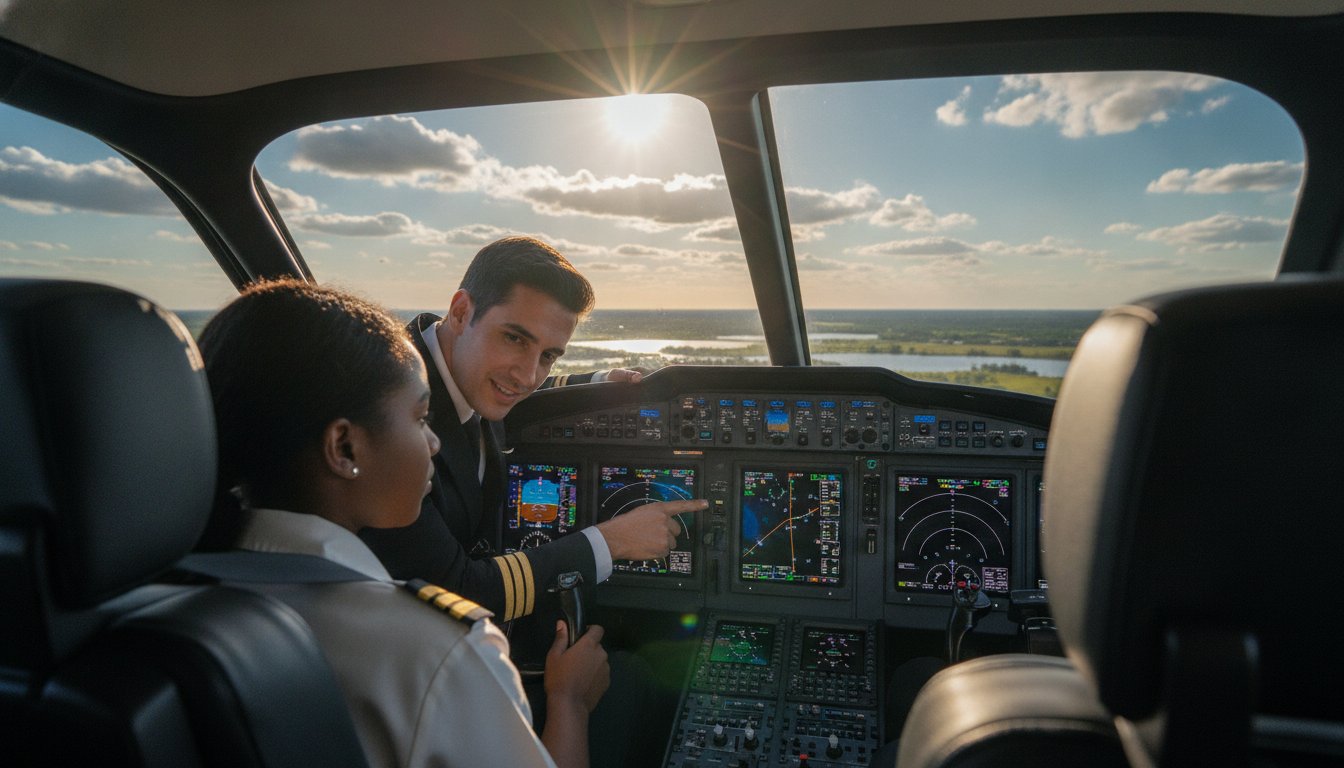
Did you know that the national first-time pass rate for the initial CFI checkride recently dropped to 73.7 percent, leaving more than a quarter of candidates grounded? This statistic highlights why pursuing your flight instructor certification Florida requires more than just technical skill; it demands a shift in mindset from being a student to becoming a professional mentor. It's completely normal to feel stressed about the intensive eight-hour practical exam or confused by complex Fundamentals of Instructing concepts while you're racing to build those 1,500 hours for the airlines.
We believe that your transition from a commercial pilot to a certified instructor should be an empowering milestone, not a source of anxiety. This guide promises to help you master the Kissimmee and Orlando airspace while providing the specific tools you need to pass your checkride on the first attempt and secure a guaranteed instructor position. We'll preview the 2026 FAA standards, explain the latest shifts in digital knowledge testing, and show you how to leverage Florida’s unique environment to accelerate your professional journey toward the flight deck.
Key Takeaways
- Discover why the CFI rating is the ultimate career catalyst in 2026, serving as the essential bridge between your commercial license and a seat at a major airline.
- Learn the latest 2026 FAA requirements and how to audit your commercial flight hours to ensure you're fully prepared for the certification process.
- Master the art of professional mentorship by learning how to translate technical flying maneuvers into effective, ACS-compliant lesson plans for your students.
- Follow a proven five-step path to earning your flight instructor certification Florida, prioritizing first-attempt checkride success and accelerated hour building.
- Gain a competitive edge by training in the high-traffic Kissimmee and Orlando airspace, preparing you for the real-world challenges of professional aviation.
Why Flight Instructor Certification in Florida is the Ultimate Career Catalyst
Earning your Flight Instructor certificate isn't just about teaching others to fly; it's about refining your own mastery of the skies. In 2026, the aviation industry faces a persistent demand for qualified pilots, making the CFI rating the most strategic bridge to a major airline career. By earning your flight instructor certification Florida, you transform from a pilot who follows instructions into a leader who creates them. This shift in perspective is exactly what recruiters look for when hiring for turbine-powered flight decks. You aren't just building time; you're building a professional reputation.
The 1,500-Hour Rule and the Instructor Path
The 1,500-hour requirement for an Airline Transport Pilot (ATP) certificate remains the most significant milestone for aspiring airline pilots. Instructing is widely considered the most respected way to build these hours because it proves you can manage a cockpit under pressure while ensuring the safety of others. When you teach a student, you're forced to understand aerodynamic principles and FAA regulations at a deeper level than you did during your own commercial pilot training. Airlines value "dual given" time because it demonstrates superior communication skills and seasoned risk management. Every hour you spend in the right seat reinforces your foundation and prepares you for the high-stakes environment of professional flight operations.
Florida’s Aviation Ecosystem in 2026
Choosing to pursue your flight instructor certification Florida gives you a logistical edge that other regions simply can't match. Central Florida, particularly around the Orlando and Kissimmee areas, serves as a premier global hub for aviation. The "Florida Advantage" is built on three key pillars:
- Consistent Flight Hours: Favorable weather allows for year-round flying, helping you reach your 1,500-hour goal months faster than peers in northern states who face seasonal delays.
- High-Density Airspace: Training in the busy Orlando airspace builds immense confidence in complex radio communications and traffic management, skills that are vital for airline transitions.
- Networking and Resources: The sheer concentration of flight schools and Designated Pilot Examiners (DPEs) in Florida means more opportunities for employment and faster scheduling for your practical exams.
This environment acts as a professional finishing school. You'll build a network of future airline colleagues and gain exposure to diverse flight operations every single day. Florida isn't just a place to train. It's the most efficient launchpad for your career, offering the high-intensity experience required to succeed in a modern cockpit.
FAA Requirements for Flight Instructor Certification in 2026
Before you can step into the role of a mentor, you must satisfy the rigorous standards set by the Federal Aviation Administration. Transitioning to a flight instructor certification Florida means moving beyond personal proficiency and proving you can maintain safety while managing a student's learning process. The legal framework for these standards is found in the FAA requirements for flight instructors, which outline the eligibility, aeronautical knowledge, and flight proficiency required for the certificate.
To begin your journey, you must meet several foundational prerequisites. These include being at least 18 years old, holding a valid FAA medical certificate, and being able to read, speak, and understand the English language fluently. Most importantly, you must already hold either a Commercial Pilot License (CPL) or an Airline Transport Pilot (ATP) certificate. This ensures you have the technical flight experience necessary to supervise others. At Aero Global Aviation Academy, we streamline this process through our Airline Pilot Elite track, which is specifically designed to take you from your initial ratings through to advanced instructor status.
As of April 2026, the FAA has fully digitalized the knowledge testing process. You'll no longer use physical supplement booklets; instead, high-resolution graphics are embedded directly into the test questions. You must pass two distinct written exams, each costing approximately $175 per attempt:
- Fundamentals of Instructing (FOI): This focuses on the theory of how humans learn and retain information.
- Flight Instructor Airplane (FIA): This covers the technical aeronautical knowledge required to teach flight maneuvers and ground school topics.
The Different Instructor Ratings Explained
The journey often begins with the initial CFI rating, which allows you to teach private and commercial students. However, most professional pilots quickly add the CFII rating, which focuses on instrument flight rules training. This is a vital skill for building the high-quality instrument hours that airlines prioritize. Finally, the MEI (Multi-Engine Instructor) rating allows you to teach in complex twin-engine aircraft, making you an even more versatile asset to any flight school.
The Fundamentals of Instructing (FOI)
The FOI exam is often the most surprising hurdle for new candidates. It isn't about flying; it's about psychology. You'll study the "Laws of Learning" and human behavior to understand why students react the way they do in a high-stress cockpit environment. Mastering these concepts is what separates a pilot who can fly from a professional who can teach. We emphasize these principles early in our ground school to ensure you're prepared for the oral portion of your checkride, where your ability to communicate complex ideas will be under the microscope.
The Transition to Mentorship: Preparing for the CFI Checkride
The most common hurdle commercial pilots face when starting their flight instructor certification Florida is a sudden wave of uncertainty. You've likely heard the phrase, "I can fly the airplane, but I don't know how to teach." This is a natural reaction to the massive shift in responsibility you're about to undertake. Moving to the right seat isn't just a physical change; it's a mental pivot from performing tasks to analyzing them. Success on the checkride depends on your ability to deconstruct complex maneuvers into simple, digestible steps for a student who has never touched the controls.
To bridge this gap, you must develop professional-grade lesson plans that align perfectly with the 2026 Airman Certification Standards (ACS). These plans serve as your script and your safety net during the evaluation. While you've already met the Official FAA CFI Eligibility Requirements, the checkride tests your ability to apply that knowledge in real time. Engaging in advanced flight training helps you refine these instructional techniques, ensuring you don't just know the material, but can actually transfer that wisdom to others effectively.
Mastering the Oral Examination
The CFI oral exam is notoriously intensive, often lasting between four and six hours. To stay mentally sharp, you should treat this portion like a professional presentation rather than a standard test. DPEs in 2026 are looking for instructors who can use modern tools to clarify difficult concepts. We encourage the use of whiteboards, visual aids, and glass cockpit training models to demonstrate how advanced avionics influence decision-making. Your goal is to show the examiner that you are a resource, not just a pilot who happened to pass a written exam.
Teaching Maneuvers from the Right Seat
The flight portion of the checkride introduces a unique physical challenge: your muscle memory is calibrated for the left seat. Everything from the sight picture during landing to the reach for the throttle feels slightly different. You must also maintain a rigorous "see-and-avoid" habit, as you're now responsible for the safety of the entire aircraft while your attention is partially focused on your "student." The instructor checkride requires demonstrating maneuvers to commercial standards while providing simultaneous instructional commentary. Mastering this multitasking is the final step in proving you're ready to guide the next generation of aviators through the busy Florida skies.
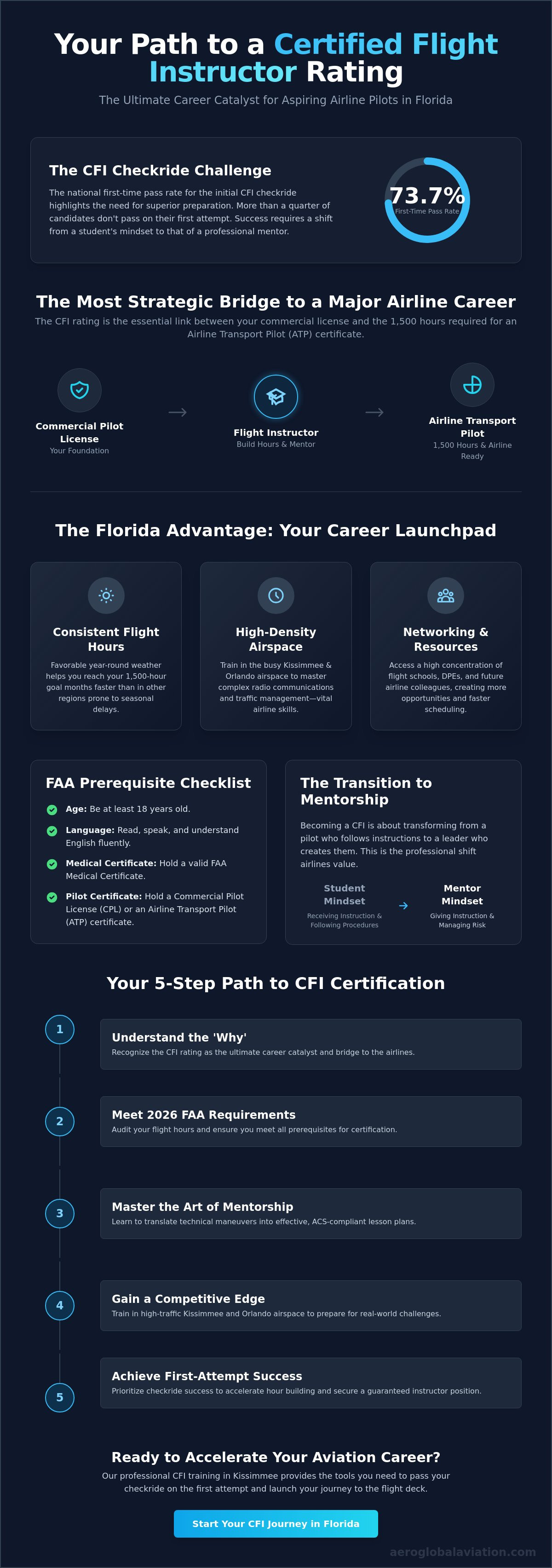
Your 5-Step Path to CFI Certification in Florida
Successfully earning your flight instructor certification Florida requires a strategic roadmap that accounts for both regulatory standards and the practical realities of a high-traffic training environment. While your commercial training focused on your own proficiency, this path is designed to build your capacity as an educator. Following a structured sequence ensures that you aren't just checking boxes but are actually preparing for the high-stakes environment of a professional flight deck. Here is how you can navigate the process from your current commercial rating to your first day as a mentor.
- Step 1: Conduct a Prerequisite Audit. Before you begin formal training, verify that your logbook is accurate and that all commercial flight hour requirements are documented. Small errors in logging can lead to significant delays when your application reaches the FAA for processing.
- Step 2: Select a Dedicated Training Program. Your choice of school determines the quality of your mentorship. You can apply for our Airline Pilot Elite program at Aero Global Aviation Academy to benefit from a curriculum that integrates advanced glass cockpit technology with traditional instructional techniques.
- Step 3: Clear the Knowledge Tests Early. Aim to pass your Fundamentals of Instructing (FOI) and Flight Instructor Airplane (FIA) exams before you start your flight hours. Completing these digital tests allows you to focus your mental energy entirely on the art of teaching once you get into the airplane.
- Step 4: Execute Right-Seat Flight Training. This phase is where you refine your lesson plans and adapt your muscle memory. You'll practice demonstrating complex maneuvers while providing simultaneous instructional commentary, ensuring your skills meet commercial standards from the instructor's perspective.
- Step 5: Pass the Practical Examination. The final milestone is the checkride with a Florida-based Designated Pilot Examiner (DPE). This comprehensive evaluation tests your endurance and your ability to maintain a safe, professional learning environment under pressure.
Choosing the Right Florida Flight School
The school you choose acts as the foundation for your career. While large pilot mills might offer high volume, a boutique academy often provides the personalized attention required for the CFI initial. You should verify instructor-to-student ratios to ensure you'll have consistent access to your mentors. Additionally, look for schools with established relationships with local DPEs, as this often leads to more predictable scheduling and a clearer understanding of the evaluation styles common in the Central Florida region.
The Accelerated vs. Traditional Timeline
You have the flexibility to choose a training rhythm that suits your learning style. A two-week accelerated "sprint" is excellent for maintaining high momentum and keeping technical knowledge fresh. Conversely, a six-week "deep dive" allows more time to digest the complex psychology of the FOI. Because Florida offers year-round flying weather, you don't have to worry about seasonal interruptions. The best flight schools in florida provide options for both paths, allowing you to reach your 1,500-hour goal on a timeline that works for you.
Aero Global Academy: Professional CFI Training in Kissimmee
Aero Global Aviation Academy isn't just a flight school; it's a dedicated community where your professional goals become tangible destinations. We designed our Airline Pilot Elite program to be the definitive path for pilots seeking their flight instructor certification Florida. We believe that becoming a CFI is the most critical transition in a pilot's life, moving from being a skilled operator to a trusted mentor. Our training focuses on building the leadership traits and communication skills that major airlines look for in their future captains. We take pride in our "Practical Mentorship" approach, ensuring that every student receives the personalized attention they need to succeed.
If you're curious about our approach and want to see our fleet in person, you can book an introductory flight lesson in Orlando to tour our facility and meet our team. You'll see firsthand how we integrate modern technology with a supportive, student-centric philosophy. It's the best way to determine if our high-standards environment is the right fit for your career progression.
Training in the Kissimmee/Orlando Corridor
Training at Kissimmee Gateway Airport (KISM) offers a strategic advantage that few other locations can match. Positioned just miles from Orlando International (MCO), our students learn to master complex ATC communications in one of the world’s busiest aviation hubs. This proximity provides invaluable professional airspace exposure, forcing you to develop the high-level situational awareness required for airline operations. KISM provides the perfect balance. It features a professional infrastructure and regional traffic density that challenges you without the constant delays found at massive international airports. When you earn your flight instructor certification Florida in this environment, you gain a level of confidence that simply isn't available in quieter rural airspaces.
Post-Certification: Instructing at Aero Global Aviation Academy
Your journey with us doesn't have to end once you pass your checkride. We frequently offer opportunities for our top graduates to join the Aero Global Aviation Academy instructor team. This allows you to build your 1,500 hours in a familiar, supportive environment while helping the next generation of students achieve their dreams. Being part of our community means networking with career-track pilots and industry veterans who share your passion for excellence. We're invested in your individual success, and we take pride in seeing our instructors move on to successful careers at regional and major carriers. The path to the flight deck is clear, and it begins with a single step toward professional mentorship.
Contact Aero Global Aviation Academy to start your CFI journey.
Launch Your Professional Pilot Career from Central Florida’s Premier Flight Deck
Earning your flight instructor certification Florida is the definitive moment when you stop logging hours for yourself and start investing in the future of aviation. We've covered the psychological shift required to teach, the technical hurdles of the 2026 FAA standards, and why the Central Florida corridor provides the ultimate training ground for aspiring airline captains. This journey is about more than a certificate; it's about refining your character, communication, and command presence. By mastering the right seat today, you're building the foundation for the left seat of a commercial jet tomorrow.
At Aero Global Aviation Academy, we don't just prepare you for a checkride; we prepare you for the high-stakes environment of a professional flight deck. Our focus on practical mentorship ensures that you leave our facility with the confidence to lead and the flight hours required to advance your career. The path to 1,500 hours is best traveled with a partner that understands your destination and has the resources to help you reach it. Your transition from a commercial pilot to a professional educator is the final step in your journey toward the airlines.
Join the Elite: Start Your Flight Instructor Training at Aero Global Aviation Academy
Frequently Asked Questions
How much does flight instructor certification cost in Florida for 2026?
Industry averages for training programs in Florida vary based on the course structure you choose. Accelerated programs typically cost around $7,500, while more traditional courses can range between $5,700 and $11,000. You should also budget for mandatory FAA fees, which include approximately $175 for each knowledge test and a $2,000 fee for the initial CFI practical exam with a Designated Pilot Examiner.
How long does it take to become a CFI in Florida?
Most candidates complete their flight instructor certification Florida in one to two months. Accelerated programs are designed to be completed in about 30 days, while standard tracks often last eight weeks to allow more time for lesson plan refinement. Florida's consistent weather helps prevent the seasonal delays common in other states, ensuring you stay on track for your 1,500-hour goal.
What is the pass rate for the CFI initial checkride?
The national first-time pass rate for the initial CFI checkride was approximately 73.7 percent in 2025. This statistic highlights the intensity of the examination, as more than a quarter of applicants don't pass on their first attempt. Thorough preparation through a structured academy and a focus on the Fundamentals of Instructing are the best ways to ensure you join the successful majority.
Can I work as a flight instructor immediately after certification?
Yes, you can begin working as a professional mentor as soon as you receive your temporary certificate from the FAA. Many commercial pilots use this certification as their primary method for building the 1,500 flight hours required for airline employment. It's a highly respected role that allows you to earn a living while gaining the leadership experience necessary for your professional advancement.
What are the FOI and FIA knowledge tests?
These are the two mandatory written exams required by the FAA. The Fundamentals of Instructing (FOI) test focuses on the psychology of learning and effective communication techniques. The Flight Instructor Airplane (FIA) test covers the technical aeronautical knowledge required to teach flight maneuvers. As of 2026, these tests are fully digital and feature high-resolution graphics embedded directly into the examination software.
Do I need a CFII or MEI to get hired by an airline?
While these advanced ratings aren't strictly mandatory for an airline interview, they provide a significant competitive advantage. Holding a CFII allows you to teach instrument students, which helps you log the high-quality instrument time that airlines prioritize. An MEI rating demonstrates your proficiency in complex twin-engine aircraft, proving you have the technical foundation required for transitioning to commercial jet flight decks.
Why is Kissimmee considered a top location for flight instructor training?
Kissimmee Gateway Airport (KISM) offers a unique balance of professional infrastructure and complex airspace challenges. Its proximity to Orlando International (MCO) means you'll learn to navigate high-density traffic and master advanced ATC communications every day. This environment serves as a professional finishing school, ensuring you develop the high-level situational awareness and decision-making skills that major airline recruiters look for in new hires.
What is the average salary for a flight instructor in Florida?
Instructor compensation in Florida is typically structured as an hourly rate for both flight and ground instruction. Some schools also offer bonuses based on student pass rates or for reaching specific hour milestones. While pay varies by facility, most CFIs view the position as a valuable professional investment that provides a steady income while they bridge the gap toward a major airline career.


