Did you know that the median annual wage for airline pilots in the United States has climbed to $226,600? While the financial rewards are higher than ever, you might feel stuck behind a wall of confusing FAA requirements and the looming 1,500-hour experience gap. It's easy to feel lost in a crowded market, wondering which school actually delivers on its promises. Choosing the right airline pilot career path Florida offers is the most critical decision you'll make for your professional future.
We believe that becoming a pilot should feel like an achievable mission, not a bureaucratic puzzle. This guide provides the exact milestones you need to move from zero experience to a major airline flight deck. You'll learn why training in the year-round sunshine of Orlando and Kissimmee creates a massive efficiency advantage for your flight hours. We'll outline a clear checklist of licenses and explain how a structured Career Pilot Program builds the confidence you need to lead a crew.
Key Takeaways
- Map out your journey with a clear, chronological checklist of FAA certifications required to reach the flight deck of a major carrier.
- Discover why the unique airspace and year-round flying weather in Orlando and Kissimmee provide a strategic training advantage for your career speed.
- Navigate the airline pilot career path Florida provides by understanding the specific 2026 industry demands and regional hiring trends.
- Master the strategy for bridging the 1,500-hour experience gap by using instructor roles to gain high-quality professional flight time.
- Identify the critical differences between impersonal "pilot factories" and structured mentorship programs that prioritize your individual success.
Understanding the Airline Pilot Career Path in Florida for 2026
Your journey to the flight deck is more than just a sequence of flight hours; it's a highly regulated progression through specific milestones. When you commit to the airline pilot career path Florida provides, you're entering a professional ecosystem designed to turn high school graduates and career-changers into commercial aviators. This journey starts with understanding pilot certification in the United States, which serves as the legal framework for every rating you'll earn. Transitioning from a student pilot mindset to a professional aviator perspective is the first real step. It means treating every ground school session and every pre-flight inspection as part of your future job at a major airline. You're not just learning to fly for fun; you're building a foundation for a high-stakes career. The ultimate goal for most is the 1,500-hour milestone. This requirement, often called the 1,500-hour rule, is the final gate you must pass before you can join a major airline as a First Officer.
The Pilot Shortage and Career Outlook in 2026
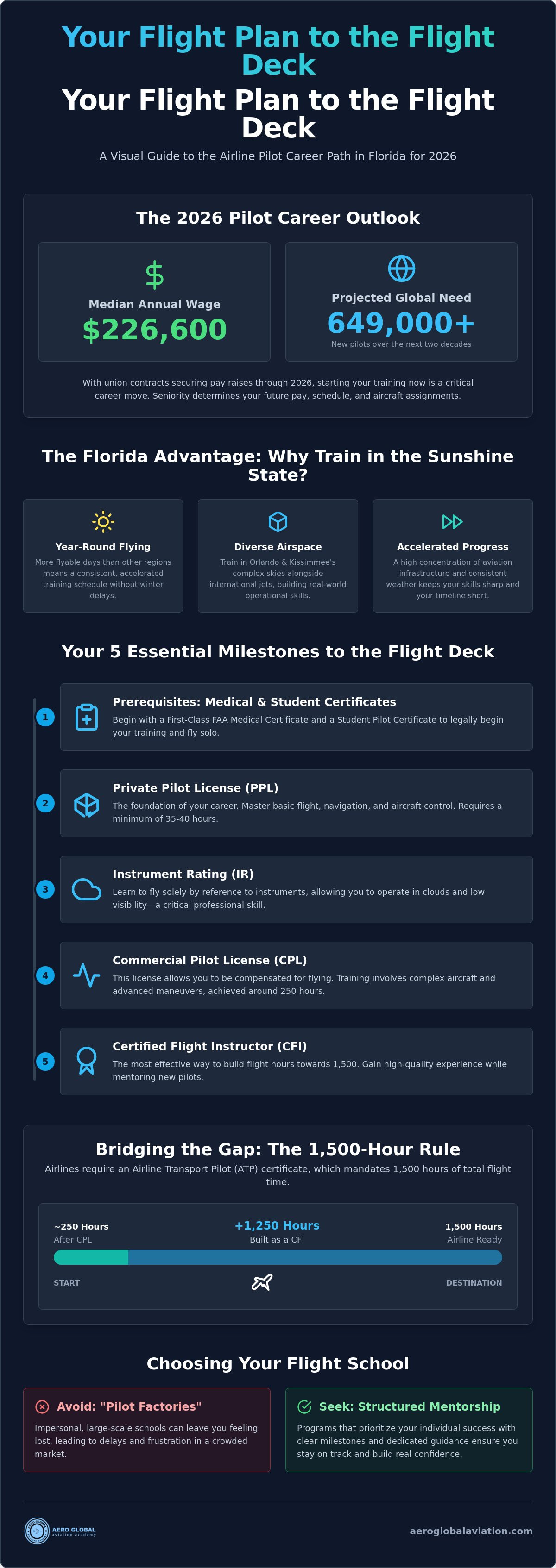
The aviation industry in 2026 is defined by a massive, sustained demand for new talent. A 2023 Boeing study projected a global need for over 649,000 new pilots over the next two decades, and those trends are hitting home right now. Major airlines have secured union contracts with annual pay raises through 2026, making this an incredibly lucrative time to start. Because airline careers are built on seniority, the day you receive your first certificate dictates your future schedule, pay, and aircraft assignments. The sooner you start, the higher you'll be on the list when it's time to bid for routes. Fortunately, the airline pilot career path has become more streamlined, with structured programs designed to move you through training without wasted time or unnecessary delays.
Why Florida is the Epicenter of Pilot Training
Florida stands as the global epicenter for flight training for several practical reasons. The most obvious is the Florida Advantage, which refers to the state's ability to offer more flyable days per year than almost any other region in the country. In states with harsh winters, students often lose weeks of progress to snow and ice. In Central Florida, you can maintain a consistent, daily schedule that keeps your skills sharp and your timeline short. The Orlando and Kissimmee areas feature a dense concentration of aviation infrastructure and diverse airspace. Training here means you'll be sharing the skies with everything from small trainers to massive international jets. This environment ensures that when you complete the airline pilot career path Florida offers, you aren't just a pilot on paper; you're a seasoned aviator ready for complex, real-world operations.
The 5 Essential Milestones of Professional Pilot Training
Achieving your professional goals requires a disciplined approach to the five major milestones of flight training. Every pilot starts with an FAA Medical Certificate, which ensures you meet the health standards required for safety. For those pursuing a major airline flight deck, a First-Class Medical is the gold standard. Once cleared, you'll apply for a Student Pilot Certificate, allowing you to fly solo as early as age 16. According to the Bureau of Labor Statistics Occupational Outlook Handbook, these initial steps are the foundation for a career that offers significant growth and high earning potential. Navigating the airline pilot career path Florida offers means understanding exactly how to tackle these hurdles to stay on schedule for a 2026 hire date.
Phase 1: The Wings Foundation (PPL)
The Private Pilot License is the bedrock of your aviation career. It's where you master the physics of flight, basic navigation, and takeoffs and landings. While the FAA requires a minimum of 40 flight hours under Part 61, or 35 hours under Part 141, the focus should always be on total proficiency rather than just hitting the minimum number. Learning how to get your private pilot license in Florida involves navigating diverse coastal weather patterns and busy airspace, which builds a superior level of airmanship from day one. Our Wings Foundation course is specifically designed to ensure this first milestone is solid before you move to advanced training.
Phase 2: Commercial Pilot Certification
After adding an Instrument Rating (IR) to fly in clouds and low visibility, you'll move toward your Commercial Pilot License (CPL). This is a major shift where you transition from a student mindset to meeting professional standards. During commercial pilot training, you'll master advanced maneuvers and high-performance aircraft operations. The FAA requires 250 total flight hours for Part 61 students, but Part 141 programs can reduce this requirement to 190 hours. This certification is what allows you to fly for compensation, opening the door to the jobs that help you reach the final 1,500-hour airline requirement. If you're ready to start this journey, exploring a structured Career Pilot Program is a smart way to maintain momentum. Once you achieve your CPL, adding Multi-Engine and Instructor ratings becomes the primary vehicle for building the professional experience airlines demand.
Why Kissimmee and Orlando Offer a Strategic Training Advantage
The location of your flight school is just as important as the curriculum you follow. Choosing the airline pilot career path Florida provides means placing yourself at the center of a massive aviation infrastructure. Kissimmee Gateway Airport (ISM) serves as a strategic launchpad, situated just miles from one of the busiest airspaces in the world. Training here gives you immediate access to diverse terrain and a high density of airports, ranging from small municipal strips to massive international hubs. This variety is essential for cross-country flight training, as it forces you to adapt to different runway configurations, lighting systems, and approach procedures. You aren't just flying in a circle; you're operating in a real-world laboratory that mirrors the environments you'll encounter as a professional aviator.
Mastering Complex Airspace Early
One of the biggest hurdles for new pilots is radio communication. By training in the Orlando area, you'll interact with Federal Aviation Administration (FAA) air traffic controllers who manage some of the most complex Class B airspace in the country. Learning to listen and respond with precision while navigating near Orlando International (MCO) builds a level of radio confidence that northern or rural students often lack until much later in their careers. This high-traffic environment teaches you to maintain situational awareness while managing the aircraft's systems. Kissimmee Gateway Airport provides a unique sweet spot because it offers the complexity of a towered field without the massive delays and restrictive taxi times found at larger international airports.
Efficiency: More Flights, Fewer Delays
Time is your most valuable asset when you're building hours toward a 2026 hire date. Florida famously offers over 300 flyable days per year, which is a massive advantage compared to northern states where snow and ice can ground fleets for weeks. This consistent weather allows you to fly daily, maintaining the "muscle memory" required to master difficult maneuvers quickly. When your training is consistent, you spend less money on "review flights" and more time progressing toward your next rating. This efficiency significantly lowers the total duration of a career pilot program, allowing you to reach the airlines months ahead of your peers. Finishing faster doesn't just save on tuition; it puts you on the seniority list sooner, which can be worth hundreds of thousands of dollars over the course of your career. Following the airline pilot career path Florida offers is the most direct way to turn your aspirations into a tangible professional reality.
Bridging the Gap: Reaching the 1,500-Hour Airline Requirement
The 1,500-hour rule often feels like the most daunting hurdle in your journey. For most aspiring aviators, the gap between earning a Commercial Pilot License (around 250 hours) and the Airline Transport Pilot (ATP) minimums is where the real work happens. This phase isn't just about logging time; it's about refining your professional judgment and mastering the "soft skills" of crew resource management. Following the airline pilot career path Florida offers gives you a unique advantage during this stage because our high-volume training environment ensures you never lack for opportunities to fly. Most pilots choose to become a Certified Flight Instructor (CFI) to bridge this gap. It's the gold standard for hour-building because it transforms you into a subject matter expert. When you teach a student to recover from a stall or navigate a complex approach, you're reinforcing those same skills in your own mind. This "teaching to learn" philosophy is exactly what regional airlines look for when hiring their next generation of First Officers.
The Airline Pilot Elite Path
Our Airline Pilot Elite program is specifically designed to move you through this transition with speed and precision. This comprehensive track integrates your initial training with the advanced certifications required to work as a professional instructor. You'll earn your CFI, CFII (Instrument Instructor), and MEI (Multi-Engine Instructor) ratings in a structured environment. Working as an instructor at a dedicated academy like Aero Global does more than just build hours; it builds a professional resume that major airlines notice. They look for pilots who have demonstrated leadership and the ability to manage a cockpit in high-pressure situations. For a deeper look at the technical requirements of these certifications, you can explore our guide to advanced flight training.
Alternative Ways to Build Flight Time in Florida
While the instructor path is highly recommended, Florida's diverse aviation economy offers other avenues to reach your goals. You might find opportunities in aerial photography, pipeline patrol, or banner towing along the coastline. Some pilots also find work in skydiving jump operations. However, major airline recruiters consistently favor the CFI path over these alternatives because of the instructional experience it provides. The ROI of earning your instructor ratings is unbeatable. Instead of paying for 1,000 extra flight hours at a rental rate of $200 or more, you're being paid to fly and mentor the next generation of pilots. This phase is the ultimate test of your dedication to the airline pilot career path Florida provides. If you're ready to transition from student to professional mentor, apply for the Airline Pilot Elite program today to secure your future on the flight deck.
Choosing the Best Flight School in Florida for Your Career
Selecting the right training partner is the final and most significant step in your journey. While the airline pilot career path Florida provides is full of opportunities, not every flight school is equipped to lead you to a major airline flight deck by 2026. You need to look beyond the marketing brochures and evaluate three critical pillars: instructor availability, a structured curriculum, and a modern fleet. A common mistake is choosing a school based solely on size. Large "pilot factories" often struggle with instructor turnover and scheduling bottlenecks, which can stall your progress. Instead, look for a "Practical Mentor" environment where your individual success is the priority and where the training culture feels collaborative rather than transactional.
Fleet and Technology Standards
The technology inside the cockpit has evolved rapidly, and your training should reflect the current state of the industry. Training on Garmin G1000 glass cockpit systems is vital for 2026 airline pilots. These integrated flight decks provide the same digital displays and automated systems you'll find in modern regional and major jets. Mastering these systems early reduces your training workload later and makes you a more competitive candidate during airline interviews. Beyond the avionics, aircraft maintenance and safety must be your non-negotiable priorities. A school that invests in a well-maintained, modern fleet demonstrates a commitment to your safety and your schedule. To help you navigate this crowded market, we've created a comprehensive best flight schools in florida evaluation checklist to ensure you're asking the right questions before you sign an enrollment agreement.
Start Your Journey at Aero Global Aviation Academy
We invite you to visit our facility at the Kissimmee Gateway Airport to see why our approach is different. We don't just teach you how to fly; we mentor you through the entire airline pilot career path Florida offers, from your first solo to your professional instructor ratings. Our flagship Career Pilot Program is a personalized, high-value track designed for those who are serious about a 2026 career start. It balances the high-stakes nature of technical training with a supportive, student-centric atmosphere that builds true confidence. The best way to start is with a discovery flight. For prospective students traveling from the Minneapolis-St. Paul area to tour our campus, you can explore Book MSP Airport Transportation to arrange professional ground transit to your departing flight. It's the moment your aspirations become a tangible reality. Contact us today to schedule your flight and take the first step toward your seat in the flight deck.
Similarly, for international students flying from London to begin their training in Florida, you can check out JAF Executive Travels for executive ground transportation that ensures a professional start to your journey.
Take Command of Your Future in the Skies
The journey to becoming a professional aviator is a path of precision, dedication, and strategic choices. By following the airline pilot career path Florida offers, you're positioning yourself in the heart of global aviation excellence. You now have a clear roadmap, from mastering the fundamentals of your Private Pilot License to bridging the 1,500-hour gap through elite instructor training. It's vital to remember that your choice of flight school determines your speed, safety, and professional readiness. You deserve a partner that offers more than just flight hours; you need a mentor that prepares you for the high standards of a major airline flight deck.
At Aero Global Aviation Academy, we provide Red Dot-level training standards and a structured FAA-approved curriculum designed for the 2026 hiring environment. Our Kissimmee-based expert instructors are ready to guide you through every milestone with personalized attention. Launch your career today with our professional Career Pilot Program in Kissimmee and turn your passion for flight into a rewarding lifetime profession. The skies are open, and your seat in the cockpit is closer than you think.
Frequently Asked Questions
How long does it take to go from zero experience to an airline pilot in Florida?
It typically takes about two to two and a half years to complete the full airline pilot career path Florida offers. You'll spend the first 10 to 12 months earning your initial ratings through a structured track like the Career Pilot Program. The remaining time is focused on building the 1,500 hours required by the FAA, which most pilots achieve by working as a flight instructor for 12 to 18 months.
What is the total cost of an airline pilot career path in 2026?
The total investment for your pilot training depends on your individual pace and the specific flight school you choose. While the costs cover aircraft rentals, instructor fees, and ground school materials, finishing your training in a high-efficiency environment like Florida can help reduce the overall duration. Many students utilize specialized flight training financing or merit-based scholarships to manage this professional investment as they prepare for high-earning airline roles.
Do I need a college degree to become an airline pilot in 2026?
No, a college degree is not a legal FAA requirement to fly for a regional or major airline in the United States. While some major carriers historically preferred a four-year degree, many have removed this requirement to address the current pilot shortage. Starting your training immediately after high school allows you to enter the industry sooner and begin building the seniority that dictates your long-term pay and schedule.
Why is Florida considered the best state for airline pilot training?
Florida is the top choice for aviators because it provides over 300 flyable days per year, ensuring your training stays on schedule without winter weather delays. The diverse airspace around Orlando and Kissimmee offers students vital experience with complex air traffic control and high-density traffic environments. This combination of perfect weather and challenging airspace creates a superior training ground that prepares you for the realities of commercial airline operations.
What is the difference between a Commercial Pilot License and an Airline Transport Pilot certificate?
A Commercial Pilot License (CPL) allows you to be legally paid for flying, and it's typically earned after 190 to 250 hours of flight time. However, to serve as a captain or first officer for a scheduled airline, you must hold an Airline Transport Pilot (ATP) certificate. The ATP certificate requires 1,500 total flight hours and represents the highest level of aircraft pilot certification in the United States.
Can I work as a pilot while building my 1,500 hours of flight time?
Yes, once you earn your Commercial Pilot License, you can work in various pilot roles to build your experience. Many students choose to become instructors through the Airline Pilot Elite program, which allows them to earn a salary while logging the hours needed for the airlines. Other common entry-level jobs include aerial photography or pipeline patrol, though flight instruction is widely considered the most effective way to master advanced concepts.
Is there an age limit to start the airline pilot career path?
There is no upper age limit to begin your airline pilot career path Florida training, as long as you can pass an FAA medical exam. You can solo an aircraft at age 16 and earn your Private Pilot License at 17. While the mandatory retirement age for airline pilots is currently 65, many people successfully transition into aviation as a second career in their 30s or 40s and enjoy decades of professional flying.
What is a discovery flight and should I take one first?
A discovery flight is a hands-on introductory lesson that serves as your first real experience in the cockpit. You'll fly with a certified instructor and actually take the controls to get a feel for the aircraft and the local airspace. We highly recommend taking a discovery flight at our Kissimmee facility first because it's the most practical way to confirm that a professional pilot career is the right choice for you.


